Long before the houses came, this ground belonged to a great estate. For more than three centuries it passed between a handful of families, from the lawyer who built Oxhey Chapel to the Blackwell family of Crosse and Blackwell, whose trustees held it when the London County Council arrived.18,35,99 Its farms and woods have their own pages, Farms and fields and The old woods.
The name Oxhey
The name Oxhey is Old English. Its old form, Oxangehæge, appears in a charter of 1007, in which King Æthelred gave the land back to St Albans Abbey.29,30 It says King Offa of Mercia had given the land to the abbey long before.29 In 1904 the scholar W. W. Skeat traced the name to the words for an ox and a hedge.30 The original charter survives in the Bodleian Library in Oxford.29,30
A contributor to Our Oxhey, working from a list of Saxon parishes he was given on a course at Oxford, sets out the bounds of Oxan-gehaege as one of three blocks of land Offa gave to St Albans. The markers run from a maple gate near Oxhey Lane, by way of a cross, a small oak and a boundary thorn, to the birch woods that are now Oxhey Woods and to Cudhelming barn at Hampermill. He reads the old southern boundary as close to the Three Rivers boundary today, and sets Oxhey beside its two neighbours in the same Saxon naming, Bushey as the hedges of Bysc and Batchworth as Baecce's farm.268
The name later travelled north. An Oxhey village history says the ground round Bushey station was known as New Bushey until the name Oxhey was taken up when the church of St Matthew was dedicated in 1880.55
A medieval park
In 1360 Roger de Louthe was licensed to enclose his woods of Gipps and Edeswyk and make a park.18 The park ended in 1598, when Francis Heydon was allowed to fell its timber and turn the ground over to crops.18,35 A sale of 1601 lists a warren lodge called Edeswick or Oxhey Lodge, along with part of the old Oxhey Park.18,35 Cussans, whose county history Our Oxhey reprints, dates the royal licence to fell the timber and plough the pasture to July 1598, and the sale to 23 July 1601, when Francis Heydon granted the mansion of St Cleere's and the warren ground to Henry Fleetwood of Gray's Inn.35 An Oxhey Lodge is marked beside today's fields on the Ordnance Survey map of 1822, very probably the same warren lodge named in 1601.40
Oxhey Place and its first two houses
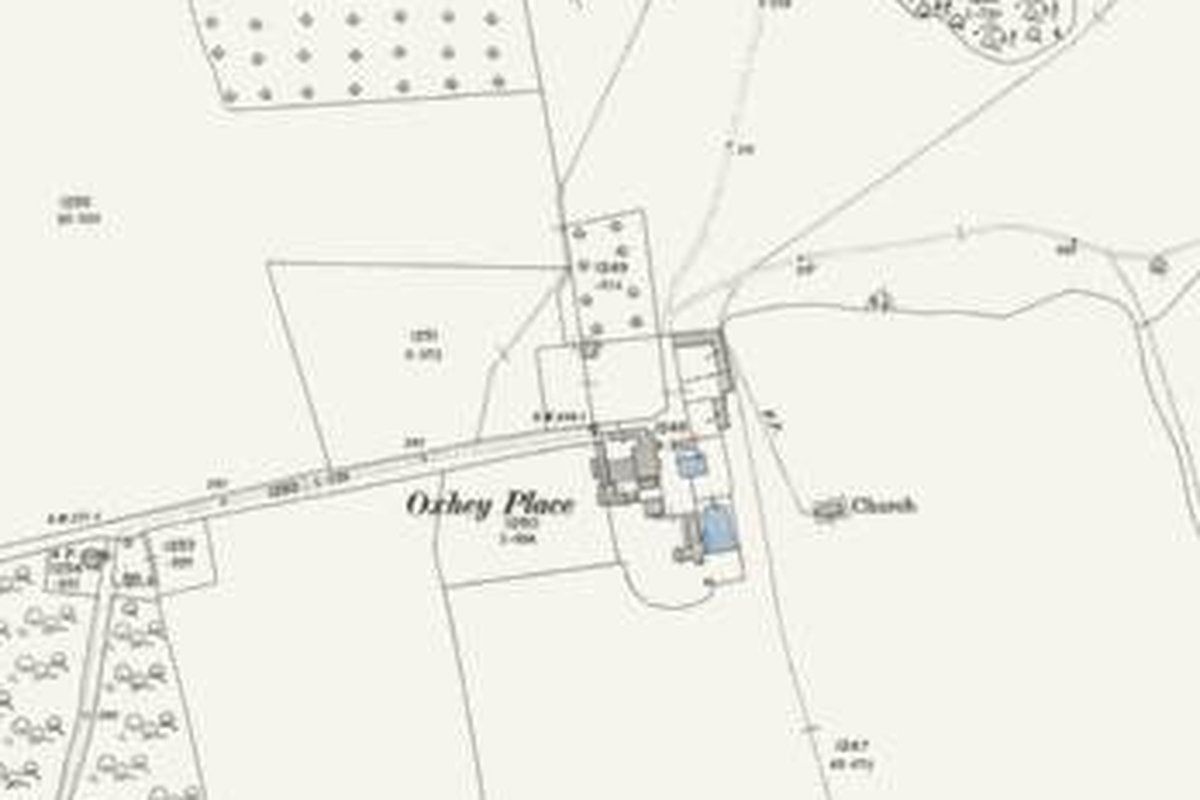
In 1604 the lawyer James Altham bought the estate.18,35 His house cost £3,000 and stood with its garden and orchard inside a brick wall enclosing 5 to 7 acres.18 In 1612 he built Oxhey Chapel, which still stands in Gosforth Lane and is listed Grade II*.19,153 That same year Altham sat as one of the judges at the Lancashire witch trials.269
William Bucknall bought Oxhey in 1668. In 1688 his son, Sir John Bucknall, pulled down the old mansion of St Cleere's, which had been Altham's home, and built a large square brick mansion said to have a hundred windows on each side.18,35,36 It was demolished in 1799, and by about 1881 Oxhey Place was just a farm, with the chapel alone in a meadow nearby.18,35
John Akam, whose book on the house came out in 2011, dates that square house to 1690, says it was built in the style of Syon Park, and says Sir John renamed the place from Sinklees to Oxhey Place.212 Nigel Lee, who has written on the chapel and its owners, also gives 1690 for the building and 1799 for the demolition. He says the William Bucknall who inherited from John Askell Bucknall in 1796, the nephew born Grimston, proposed selling Hedgestone Farm in the parish of Harrow to pay for a replacement house at Oxhey, which was never built, and that the Bucknalls' remains lie in the chapel vault.39
The Bucknall heirs and the Estcourts
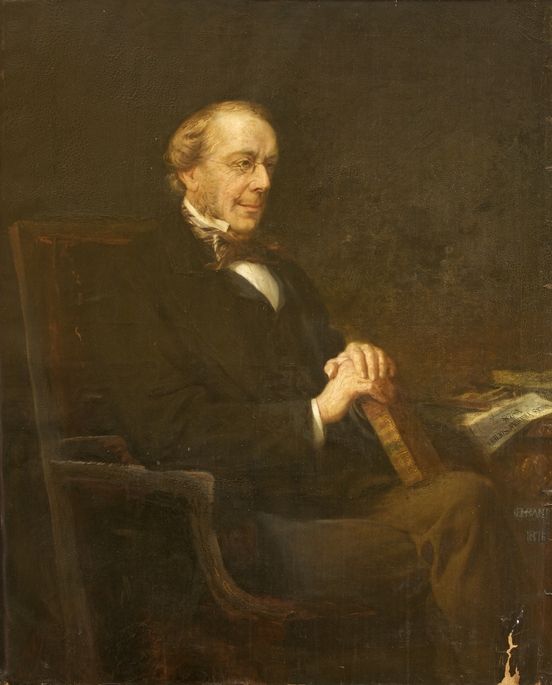
The Estcourts' link with Oxhey began with a marriage, according to Our Oxhey's note on the estate records. Thomas Estcourt married Jane, a daughter of Viscount Grimston, on 6 October 1774, and he died on 2 December 1818 aged 70.39
John Askell Bucknall died unmarried in 1796. His will passed Oxhey first to his nephews William and Harbottle Grimston, and after them to their sister Jane, the wife of Thomas Estcourt.18,49 Each heir had to take the surname Bucknall. Both nephews did, and both died without sons, William in 1814 and the Rev. Harbottle Bucknall in 1823.18,42 By then Oxhey Place was simply a let farm.49
In 1823 Jane's son Thomas Grimston Estcourt, MP for Devizes, was given royal leave to use the name Bucknall, as the will required.41,42 Sources disagree on whether Oxhey came to him in 1823 or only after his mother died in 1829.18,42,49 He died in 1853 and his son Thomas Henry Sutton Sotheron Estcourt took over.44,49 He was a Conservative MP and served as Home Secretary from March to June 1859. A paralytic seizure ended his public life in 1863, and he died in 1876.44,45
Hertfordshire Archives holds the Bucknall and Estcourt estate papers for Oxhey, covering 1670 to 1888.39
The 1866 sale and W. H. Smith
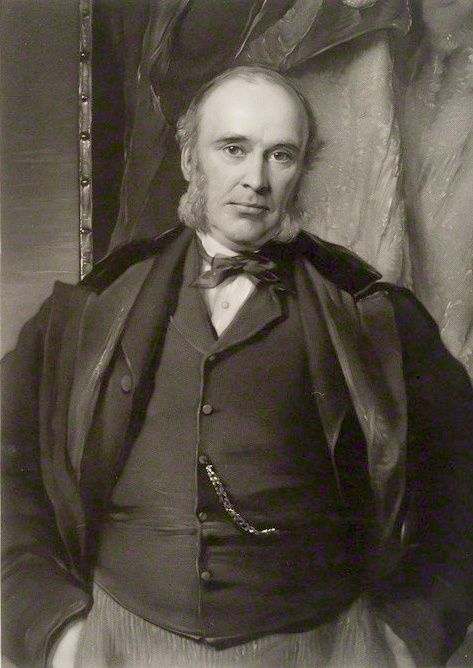
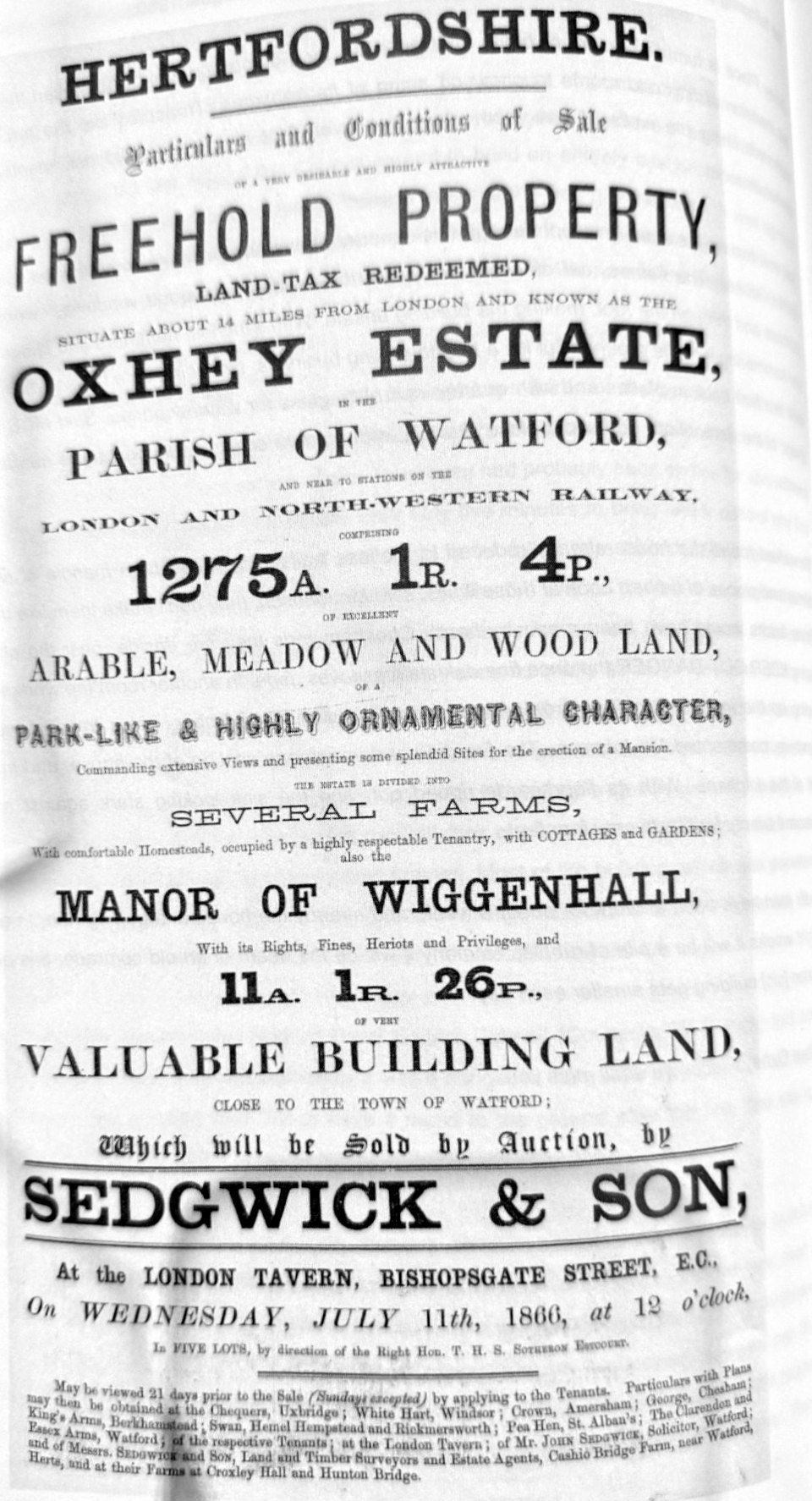
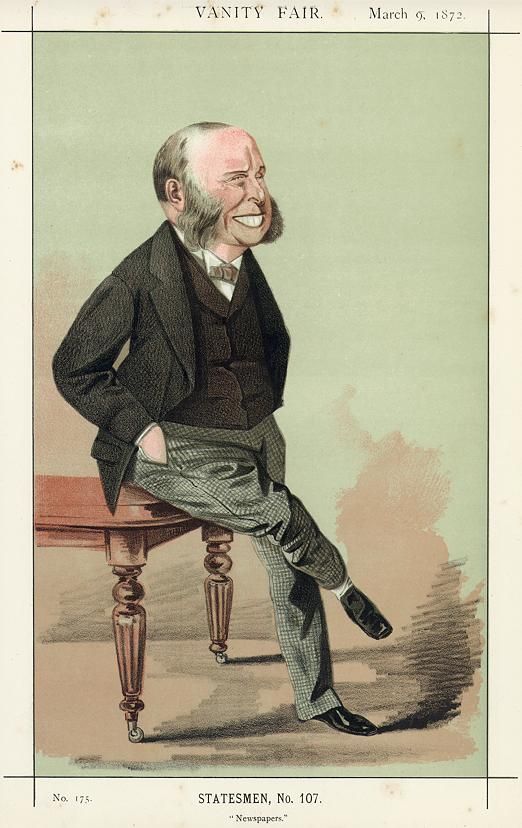
On 11 July 1866 Sotheron Estcourt put the Oxhey estate, 1,275 acres, up for auction at the London Tavern in Bishopsgate Street.20 It was sold that day to William Henry Smith.18,35 This really was the newsagent of W. H. Smith and Son, who later became Leader of the House of Commons. His family's own estate papers, now at the University of Reading, record the purchase.49
Smith never made Oxhey his home. The Reading catalogue describes his Hertfordshire land as simple investments, and nearly 200 acres were sold off as building lots.18,35,49 By 1872 the estate was down to 1,094 acres.20,35
The neighbours at Oxhey Grange
Next door, Oxhey Grange was built for W. T. Eley, in 1876 according to its listing, though Watford's appraisal gives 1866 to 1867.52,87 It later belonged to the painter James Doyle Penrose, father of the artist Roland Penrose.270,271 After his death the Grange estate was auctioned on 7 July 1932, with farms and woods offered as fit for "early Building Development".86 The St Meryl estate at Carpenders Park, on the far side of the railway, was begun in 1935, about a decade before the council estate.89
The auction of 1872
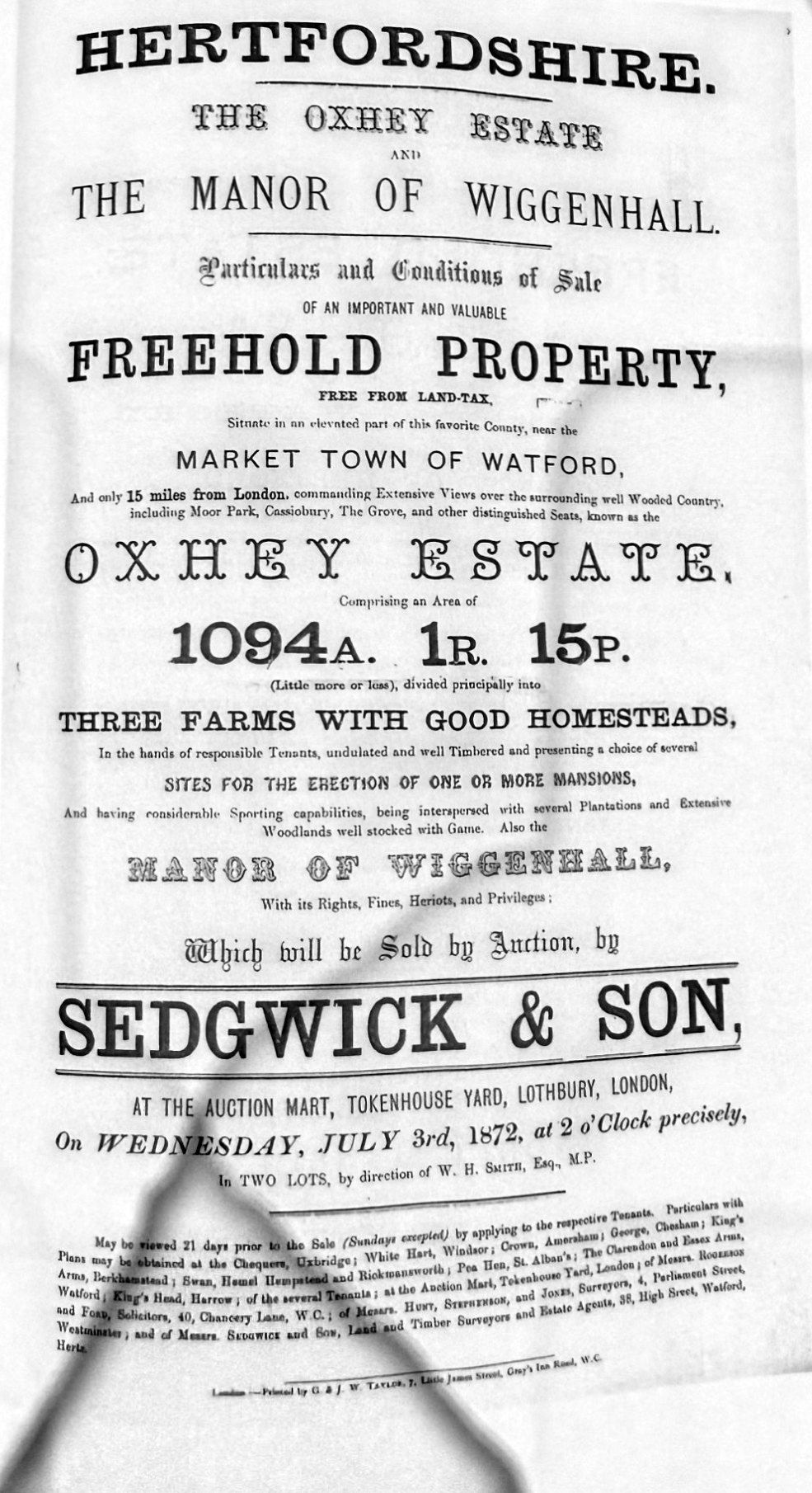
On 3 July 1872 Smith offered "The Oxhey Estate and the Manor of Wiggenhall" at the Auction Mart in Tokenhouse Yard.20,51 Only the Manor of Wiggenhall changed hands that year. It went to William Thomas Eley of Oxhey Grange, the estate next door.18,49 The main estate did not sell. Cussans says it "remained in the market for five years".35
The sale papers show that Oxhey Place and Ranger's Farm, 383 acres, was already let to "Thomas Blackwell Esq." as a yearly tenant.20 The buyer would also have to repair Wiggenhall Bridge, and the arrangement for services in the chapel would end at Michaelmas 1872.20
Thomas Blackwell buys Oxhey
In 1877 the tenant became the owner. Thomas Blackwell was the co-founder of Crosse and Blackwell, the London food firm he and Edmund Crosse took over in 1830.18,35,49,82,272 One source names the buyer as Thomas F. Blackwell, his son, but the older records and the 1879 London Gazette make clear they were two different men.54,273
In October 1877 Canon Gee told the Watford Natural History Society about the Grimston Oak, "at the fence of Mr. Blackwell's farmhouse" near the chapel. He said the Grimston family had left the tree "to the care of the new proprietor".53
Blackwell also paid for pictures of his new estate. The painter Frederick Goodall RA, who built Grimsdyke at Old Redding, had Blackwell as his main patron, and Our Oxhey carries a rare etching by Goodall of the estate pond with Oxhey Place and the chapel behind it. Contributors there say Blackwell commissioned the etching in 1878 and a painting of the house as well, which has not been traced.274 The pond is on the Farms and fields page.
Blackwell still lived at Harrow Weald, and in 1879 he and his son helped pay for the new church district of St Matthew, Oxhey.54 He died later that year.35
The Blackwells after 1879
Thomas's son Thomas Francis Blackwell had Oxhey Place, while another son, Samuel John Blackwell, held the farms to the north.18,82 By 1913 the golf company was one of Samuel's tenants.82 T. F. Blackwell was a High Sheriff of Middlesex and twice Master of the Salters' Company.66 He restored the chapel in 1897, as Oxhey Chapel tells, and died in 1907.18,63
T. F. Blackwell's son Walter Reginald Blackwell was living in the new mansion at Oxhey Place by 1908.18 In 1911 Walter built a red-brick memorial hall and club at Oxhey in his father's memory, seating 300.66 He died on 10 October 1912, six months after his only son was born.68,72 Kelly's Directory of Watford for 1925 calls his memorial hall the parish hall, built in 1911 as W. R. Blackwell's gift, and gives its capacity as 400.43
Walter's will left Oxhey Place in trust for that son until he turned 21. His widow could live in the house for as long as she stayed his widow, and the farm and other land were to be let.73 So from 1912 to 1933 trustees ran the estate. A tax case over the boy's income went to the Court of Appeal in the 1920s. The courts held that his interest was only contingent until he came of age.73 A related tax ruling in the same dispute, that income held back for a minor is not the minor's own income, is still cited in trust law.275
Two of Samuel John Blackwell's sons were killed in the Great War. Second Lieutenant Charles Blackwell of the Royal Fusiliers was killed in action on 20 July 1915, aged 32, and Bushey Museum's roll notes that he is commemorated with his brother at St Matthew's church.276 That brother was William Gordon Blackwell, who joined the Honourable Artillery Company at the outbreak of war, was commissioned in the 4th Royal Fusiliers in 1915 and fell at Flers on the Somme on 5 October 1916, aged 31.277
Oxhey Place: the Blackwells' mansion
The third house at Oxhey Place was the Blackwells' mansion, which the Victoria County History called entirely new in 1908.18 Published building dates vary, but it is missing from the map revised in 1896 and shown on the one revised in 1912 to 1913.36,58,59 Nigel Lee, correcting his own 1971 article on Our Oxhey, says that after the Bucknall mansion came down in 1799 there was no big house at Oxhey, apart from the White House farmhouse, until 1900, when T. F. Blackwell had the mansion built for his son Walter, and that it was completed in 1912, the year Walter died and Anthony Blackwell was born.36 On another Our Oxhey page he puts the building between 1903 and 1912.274 David Reidy says the neo-Jacobean house was finished by 1910 and later extended, and had about fifty rooms, with a ceiling of sixteen carved oak panels in the entrance hall.108 In the war most of the front ground-floor rooms were shut up, the family lived upstairs, and evacuee families lived in the staff quarters.108 In 1943 the estate employed fourteen workmen and kept 200 pigs and a pedigree herd.93
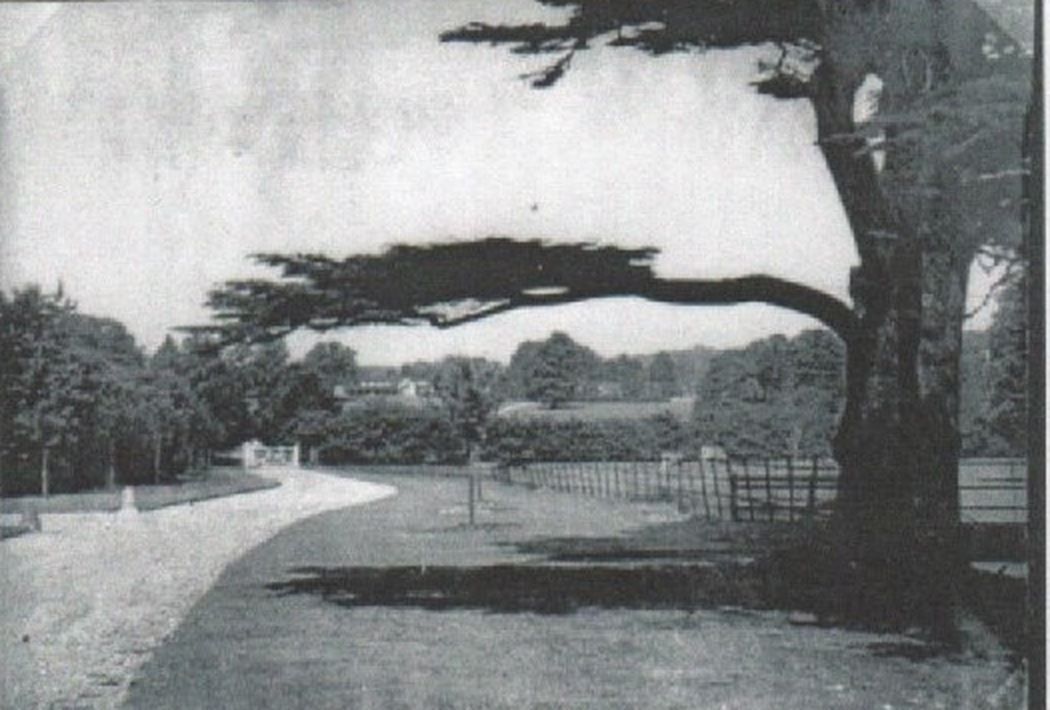
One photograph shows what the approach to it looked like. It was taken on a summer morning in the 1930s, looking north up the drive towards Green Lane and the golf clubhouse, with the drive curving away left towards the mansion.278 The tree filling the right-hand side is a cedar of Lebanon standing in the grounds of Oxhey Chapel, and John Swain, who wrote the caption, notes that it was already more than a hundred years old when the picture was taken and was still there in 2004.278 Its lowest branch reaches clean across the drive. If you want one image of what the London County Council bought, this is it: a private park with a gravel drive, white gates and a cedar.
Residents remember the war years too. One resident recalls evacuees housed in the Blackwells' house, and one such family moving into Fairfield Avenue when work on the estate began.279 A resident on the Carpenders Park side remembers searchlights placed on the golf course and the army occupying Highfields in Oxhey Lane.280
The house had one last use. After the London County Council bought the estate, the estate's first doctors and its baby clinic worked there, and a resident remembers visits from about 1950.108,281 A new health centre was finished on Oxhey Drive late in 1957, and the house had stood empty and boarded up for about a year when fire gutted it on 4 July 1960.108,119,146,153 The doctors and the baby clinic are covered in Shops, pubs and services. A resident who came to the estate in 1954 remembers playing in the house and hunting for a rumoured secret passage from under the staircase to the chapel. What he found instead was a small servant's room under the eaves on the north side, just big enough for a bed, a wash-stand and a cupboard, with a beam worn smooth.279 When the house burned in 1960, four brothers from Trevose Way watched the firemen at work.279
The fullest account of the house is John Akam's Four Hundred Years of Oxhey Place, Houses and People, published in 2011. He was the son and grandson of Oxhey Place staff, and five pages of his book come from an unpublished biography by Michael Strachan. Copies were sold through South Oxhey Library at £7.212 Writing in 2015, David Reidy said only two people who had lived at Oxhey Place were then still alive, one of them Akam, born in 1936.88
How the northern farms left the family
An abstract of title kept at Hertfordshire Archives, summarised on Our Oxhey, follows the northern farms out of the family's hands. Samuel John Blackwell, who had taken the land on his father's death in 1879, mortgaged Oxhey Lodge Farm, Oxhey Hall Farm, Broadfield and part of Oxhey Bridge Farm for £6,000 in August 1910, and again for £5,000 in August 1913. The second schedule names his tenants, among them Hertfordshire County Council and The Oxhey Golf Club Ltd. Both loans were cleared, the later one in June 1920, and Blackwell died on 26 January 1923, with four of his sons as his executors and trustees.82
On 3 October 1924 the four brothers sold Oxhey Lodge Farm, with parts of Oxhey Bridge and Oxhey Hall farms, 134 acres in all, to David John Davies of Wembley for £12,500. Broadfields House was left out as an island of land, with a right of way to it along Broadfields Lane, and the sale set conditions on what could be built.82 In July 1932 Davies had those conditions relaxed for part of the land so that semi-detached houses could go up, and on 5 October 1933 he sold that part to Oxhey Builders Ltd of Watford, who borrowed £6,300 from a Norwich building society to lay out "a new road called or intended to be known as Raglan Gardens".82 That is how the farmland just beyond the golf course became the Oxhey Hall estate of the 1930s, about a decade before the London County Council took the rest.82
Anthony Blackwell and the trustees
Anthony Blackwell, born in 1912, inherited the estate in 1933.68,88 By 1939 he was sole owner of the golf club. In 1941 he said he did not want houses built on the course, which he saw as "an amenity to his house".3 Its story is told in Oxhey Golf Club.
He served as a Second Lieutenant in the Royal Artillery and died on 5 July 1942, aged 30. He is buried in the small enclosure at the west end of Oxhey Chapel.68 His son was a small boy, so the estate went back to trustees.88 Those trustees fought the London County Council at the 1944 inquiry and lost, as The 1943 Housing Order explains.4,99
David Reidy, writing about the family in 2015, says Anthony was killed by an explosion on wartime service, that the council bought most of the estate from the trustees in 1944 for £199,500, which he put at about £7.7 million when he wrote in 2015, and that the Blackwells then moved to a small manor house in Wiltshire. He adds that the family had held land at Harrow Weald, Bushey and Chipperfield before buying Oxhey in 1877.88
The heir who lost it lived until 2014. Anthony's only son, Charles Blackwell, was a small boy when his father was killed and too young to inherit. He later became a solicitor, and he died in October 2014, aged 79. Reidy says it took him many years to accept the loss of Oxhey.88
The owners at a glance
Poor But Proud lists the owners of the Oxhey estate from Saxon times to the London County Council's purchase.282 It dates Altham's purchase to 4 April 1603, a year earlier than Cussans's 4 April 1604.35,282 It also has Anthony Blackwell inheriting in 1912, as a baby, where other sources say he came into the estate in 1933.18,88,282 Its last owner is dated 1943, the year the council made its order, and the table below gives 1944 instead, when the purchase was confirmed and came into force.97,282
| From | Owner |
|---|---|
| 757 to 796 | King Offa of Mercia gives the district to St Albans Abbey |
| 1007 | King Æthelred confirms the grant to the abbey |
| 1539 | The abbey is dissolved and the estate passes to the Crown |
| 1566 | Francis Heydon |
| 1601 | Henry Fleetwood |
| 1602 | Robert Bowyer and Richard Fusse |
| 1603 or 1604 | James Altham |
| 1617 to 1630 | Altham's son Sir James, then Sutton Altham, who died in his eighth year |
| 1630 | Elizabeth Annesley and Frances Vaughan |
| 1639 | John Heydon |
| 1668 | William Bucknall, then his Bucknall heirs until 1814 |
| 1814 to 1823 | Rev. Harbottle Grimston, later Bucknall |
| 1823 to 1866 | Jane Estcourt, then her son and grandson |
| 1866 | William Henry Smith |
| 1877 | Thomas Blackwell, then his son, grandson and great-grandson |
| 1944 | The London County Council, by compulsory purchase |