South Oxhey was laid out along a railway that was already there, and the station beside it had been open since 1914, built for golfers.397 For the first families the train was how they arrived and how they got to work, buses reached the estate only slowly, and nearly everything else meant walking.116,614
The railway before the halt
The station at Carpenders Park, when it came, stood on new tracks. Parliament had approved two more lines beside the Euston to Watford main line in 1907, to be joined to the Bakerloo at Queen's Park, work began in 1909, and the new pair was electrified at 630 volts direct current from the railway's own power station at Stonebridge Park.64
The golfers' halt
Oxhey Golf Club opened in May 1912, and after representations from the club the London and North Western Railway opened a station at Carpenders Park on 1 April 1914.397 It was a plain wooden halt, provided for club members, most of whom came from north London, and for a few scattered houses.397 It stood a few hundred yards south east of the clubhouse, about seven minutes' walk, and only certain trains called there, during golfing hours and then only on request.397 The golf course tells how the club came to have a station of its own.
Each platform was 350 feet long, 9 feet wide and 2 feet 9 inches above rail level.397 There was a booking office and waiting room on the down platform, a smaller waiting room on the up platform and a footbridge between the two, and a signal cabin beside the down platform held six working levers and two spaces.397 Golfers reached the down platform by a flight of steps and a path from the course, through a kissing gate, and the footpath ran on beside the platform towards the cattle tunnel.615,616 A resident remembers the nameboard reading Carpenders Park, with the words for Oxhey Golf Course underneath, and says the sign came down when building of the estate began and the course was sold to the London County Council.398
The halt closed at the end of 1916 as a wartime economy, on 31 December according to Our Oxhey and on 1 January 1917 according to Wikipedia, and it did not reopen until 5 May 1919.74,75 Public electric services had been extended over the new line from Willesden Junction to Watford Junction on 16 April 1917, while the halt was shut, and when it reopened only Bakerloo trains called there.74,75 London and North Western Railway trains, by then electric, called there again from 10 July 1922, the same day direct services to Broad Street started.74,75
The wooden station
In 1923 the station took 9,209 passengers.75 That July there was a half-hourly service to Euston, on Sundays as well, at 2s 9d second class and 1s 8d third.75 Neil Hamilton has posted extracts from a large rolled engineer's drawing of the station dated 10 March 1924, when it was less than ten years old.617 The electric units that came into service in 1925 were reckoned the most comfortable suburban trains in the London area.75 From September 1926 every train was advertised to call on request only, Sunday trains were timed to call again from the summer of 1928, and a full service with longer opening hours came in from the winter of 1935 to 1936.75
The St Meryl estate, on the far side of the line, began to be built in 1935, and the halt started to look inadequate.89 David Reidy's account cites The Times of 3 September 1935, which reported that the LMS had contracted a Staffordshire company to extend the station footbridge over the four main line tracks.89 That saved St Meryl residents from reaching the station through the cow arch, a tunnel under the railway north of the station, on a route that had caused disputes with the Blackwell family as owners of the Oxhey estate.89 Frederick Absalom, the St Meryl developer, helped pay for the work.89 By 1937, as St Meryl grew, the station was handling some 200,000 passengers a year.89
Residents remember the old station well.618,619 The waiting room had fixed wooden seats and walls covered in railway posters, and its coal fire was kept going with coal the porter gathered from the track after it fell from locomotive tenders.618 There was no ticket barrier and no inspector's box, and the duty porter collected tickets, changed the destination board and kept the place tidy.618 The oil lamps earned the halt the local nickname Paraffin Junction, and the electric dish lamps on curved supports that replaced them the nickname the Dog Track.619 Because the lights ran off the railway's own supply they dimmed noticeably when two trains started at once, but stayed on when the Watford mains failed.619
In the 1940s a resident remembers the pattern of trains running Broad Street, Bakerloo, Euston, Bakerloo, with the Bakerloo trains going through to Elephant and Castle, and evening services ending at Bushey, Croxley Green, Rickmansworth or Watford Junction.415 Before the estate was built, families took the train to Watford High Street and changed for Rickmansworth Church Street station, almost opposite the Aquadrome, which was the nearest thing to a day at the sea.620 That passenger service ended on 3 March 1952, although a reader says goods trains ran on the line through the 1960s, serving the paper mills at Croxley and the pumping station at Hampermill.620,621
From 1947 the halt became the estate's front door.614 New families were met off the train by the Co-op, the Express Dairy, the coalman and council officers, and a local dairy drove bewildered arrivals up to see their new homes and answered their questions about shops and schools.614 One family living in Holloway Road took the train out from Highbury before their move, to watch their house being built and wait for it to be finished.445
Many kept their London jobs.622 In 1948 a workman's early morning ticket to Euston cost 1s 9d if it was used before 07.30, a return to Watford cost 6d, and there were long queues on Sunday evenings for five day tickets.622 David Reidy writes that anyone at the station at 6pm on a weekday saw a formidable number of people coming home from work.622 The Euston train was slow, stopping 18 times from Watford Junction, and a commuter counted seven more stops on the run to Broad Street.64,138 A woman who worked in London did her shopping in her lunch hour and carried the bags home in the ladies only compartment.483
By 1951 the station was plainly worn out.461 It still had two old railway sleeper platforms and a small gas-lit wooden booking office and waiting room, with queues at the ticket window at rush hour and crowding on the footbridge and the platforms every day.461 David Reidy's account gives the traffic then as some 20,000 passengers, without saying over what period.461 Widening the platforms was out of the question because the steam main lines ran so close, so only a new station would do.461 The West Herts Post of 6 August 1951 reported that things had been eased a little by an extra ticket office, opened after representations from passengers and the St Meryl Residents' Association.461 A woman who moved to Prestwick Road in 1951 remembers the station as still just a wooden platform.116 A woman who came to the top of Prestwick Road in the early 1950s remembers it as still a golfing halt, where you rang a bell to make a train stop.480
Commuters from the estate often saved time by taking the slow train to Harrow and Wealdstone and changing there onto a non-stop express, which is why the crash at that station on 8 October 1952, in which 112 people died, was felt so sharply in South Oxhey.138 On the morning of the crash a schoolgirl from the estate was on a train that had already called at Harrow and Wealdstone when it was halted just outside Kenton, and railway workers brought wooden steps to help the passengers down and back to the platform at Kenton.138 For about two weeks afterwards a bus linked the two severed sections of railway between Headstone Lane and, as she remembers it, South Kenton.138
Walking and cycling
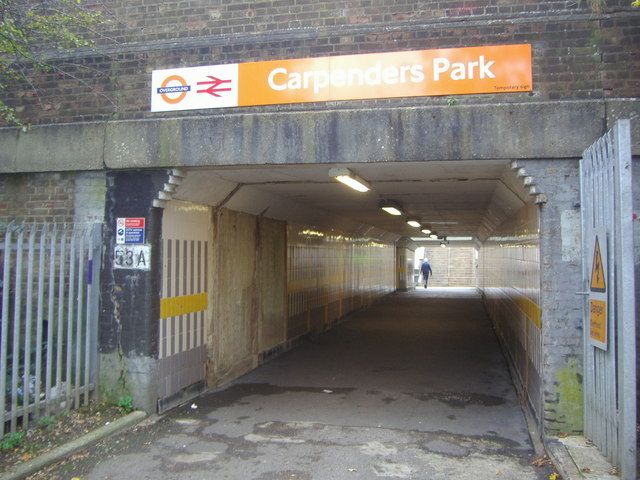
In the early years people walked everywhere.116 The shortest way to Carpenders Park and the shops on that side was the cattle arch under the railway.115,479 On one family's moving in day in July 1948 the removal van came round by Carpenders Avenue and tried the arch, which cars could still drive through then, and stuck fast because the driver had not allowed for its height.115 Another tenant of 1948 remembers walking through the same arch when it was being used as a cow shed.479 An oral history recalls the tunnel being divided, one part for the farmer's cattle and one for people on foot, and a path beyond it that led to Watford Fields and on to Watford through Bushey.623
Children made a day of the same route.115,623 They turned right out of the tunnel, went through a copse to a second cattle tunnel, came back under the railway and followed a footpath past a cattle bridge to Watford Heath, stopping on the way to watch steam engines scoop water from the troughs between the rails.115,623 Children living on the far side of the line walked through the station tunnel to school.570 Walking was also how fuel came home, and one resident remembers the trip to the gas works for coke, wheeled back in the baby's pram two or three times a week when there was money for it.446 Accounts differ over which gas works, Watford Lower High Street or Bushey Arches.446,523
The Watford Observer's 1996 look back at the estate says another footbridge over the railway was installed in 1958, about ten years after the first tenants came.142 Bicycles filled the gaps.115 During a bus strike about 1960, with no 346E to Watford Technical High School, pupils from the estate rode there and back instead.115 Crossing the roads was the other problem.161 On 13 October 1963 residents protested about the lack of a pedestrian crossing, and the Watford Observer photographed mothers pushing prams across the road, men with placards and what looks like a petition being collected.161 Neil Hamilton says the spot is where the crossing near Carpenders Park station is now.161
The gap in the road network never closed.624 There is still no road across the railway at South Oxhey, so people walk through the narrow tunnel to the station while cars face a detour of about a mile.624
Buses
The first bus link to Watford began in June 1950.23 A family who moved to Hayling Road in 1950 had a five-minute walk to Sandy Lane for the unreliable 345, later renumbered 347, which went to Watford or Northwood.487 A woman who arrived in 1951 found the buses came no further than halfway up Prestwick Road.116 Quoting David Reidy's history, John Swain says two services began on 5 March 1952, the 346 between Kingswood and Hayling Road and the 346A between Kingswood and Ormskirk Road.133 The 346B began on 7 January 1953 as a feeder to Carpenders Park station, running between Hallowes Crescent and Little Oxhey Lane at Ormskirk Road by way of Hayling Road and Prestwick Road, Mondays to Fridays at peak hours only.133
A contributor writing in 2011 recalled only three services in the wider Oxhey area at first, the 346 between Kingswood in Watford and Hillcroft Crescent in Hampermill Lane, the 302 from Hemel Hempstead to Watford Heath and the 311 from Watford to Shenley.487 The Our Oxhey contributor who wrote in 2011 had been told, although David Reidy's dates show the 346 and 346A running from 5 March 1952, that the 346 started serving South Oxhey about 1960, with a 346A circular by way of Heysham Drive and a rush hour 346B running from the station by Hayling Road, Sandy Lane and Prestwick Road and back.133,487 A reader replied that the 346A was running well before 1960.487
Once the estate roads were tarmacked the 346 ran from the Harebreaks to Hallowes Crescent, where it terminated by the new shops, and it was later extended to Dumfries Close, although the blinds still showed Hallowes Crescent for years.487 In the early 1960s it ran down Hayling Road to Dumfries Close and reversed into the close, and in dense fog someone stood on the corner with a flaming torch to guide the driver in.487 The 347 ran up Hampermill Lane, a resident thinks between Uxbridge and Garston garage, and in the 1970s it split, with a 347A running through the estate up Prestwick Road.487 In 1974 the local MP told the Commons that 59 parents had petitioned about the 346D from South Oxhey to North Watford.625 A family moving from Hemel Hempstead in January 1976 came by bus with two large suitcases because the trains were on strike.626
The new station
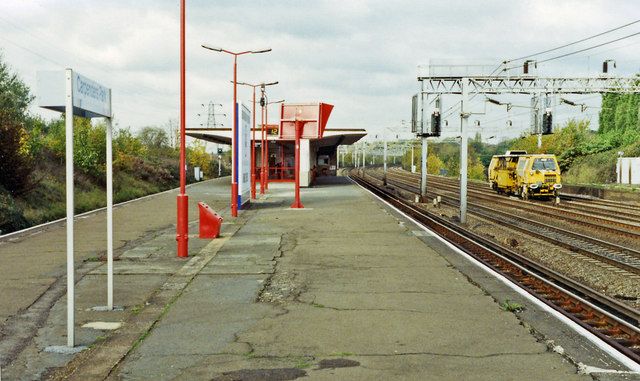
The new station, a short way south of the halt, came into use on 17 November 1952 and was formally opened on 27 September 1954, as A proper station explains.74,139 Looking back in 1996, the Watford Observer put the cost at £90,000, and said that in 1954 local traders objected to the name Carpenders Park, on the grounds that the place never had been Carpenders Park and never would be.142 One Our Oxhey writer dates the plan to rebuild the station with a central island platform to the late 1950s or early 1960s, under a scheme called new stations for old whose other station was Gospel Oak, which does not fit the station's own opening dates.64,139 The old wooden platforms are said to have been taken away and re-used at Shefford in Bedfordshire.618
Passengers reached the new platform down Station Approach, by steps or by a longer ramp, then through the underpass and up a long ramp to the ticket office.64 Past the ticket windows stood a blue and white machine that sold half a pint of milk or orange for sixpence, cast iron chocolate machines that took a strong arm to work, and a cigarette machine that gave tokens towards a free gift.64,301 Then came the barrier, where a ticket collector stood with his clippers, and a paper shop that opened at peak times.64 A booking clerk who worked there in 1968 says he refilled the chocolate and cigarette machines in the booking hall and was paid sixpence in the pound for it.301 A resident remembers horses painted on the waiting room walls by a young woman, and station garden competitions that Bushey and Oxhey station, as Bushey was then called, won several times.483
The new layout had one bad fault.64 Leaving by the proper route meant a long walk round to Woodhall Lane and the roads north of it, so some passengers crossed the live rails and climbed a fence instead, and a number were electrocuted.64
Other changes on the line came slowly. Neil Hamilton remembers the concrete blocks that carried the old footbridge supports standing until the early 1980s, when Hartcran House and its car park were built beside the railway.616 Bakerloo trains called at Carpenders Park until 1982.74 The direct current lines were worked with what the railway called a calling on light, a second signal that let a train held at a red for two minutes draw carefully up to the signal ahead, and it was used until the early 1990s.64 A passenger remembers being told that the new station's longer island platform was for the longer trains of the future, but says trains there were cut from six carriages to three, and went back up to four only after London Overground took over.627
On 1 April 2014, the centenary of the first station, a blue plaque was unveiled there at 1pm in front of a crowd of more than 50 people, by a representative of London Overground Rail Operations.218,219 Watford Rural Parish Council paid for the plaque, Three Rivers District Council was represented, and the local historian David Reidy, who wrote a history of the station from 1914 to 2014, organised the day.218,219 Afterwards everyone walked to Oxhey Library for an exhibition on the station's history.218 The station is now on London Overground's Lioness line.74