The company and the Blackwell lease
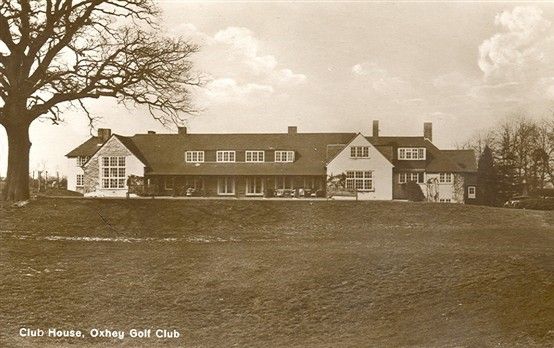
The course sat on part of the Oxhey estate, which Thomas Blackwell of Crosse & Blackwell had bought in 1877.18 A local history sheet says the Blackwell family set up the club in 1910 as a limited company with £1,500 of shares.65 The Oxhey Golf Club Ltd played on land leased from the family.3 The same sheet puts the first clubhouse where The Pavilion now stands in Green Lane.65
Vardon's layout and the opening match
Harry Vardon laid out the course, and Sporting Life in 1927 says it was made by Pulford senior, adding that so much ground was given them that they could avoid parallel fairways altogether.10 1,65,69 The history sheet says the club engaged him as soon as the Blackwell family founded it.65 John Swain writes that the course lay on a belt of natural sand over chalk, good ground for bunkers, with old pits and quarries as extra hazards. It was built by hand, with horses pulling scoops, which gave the earthworks a natural look.7
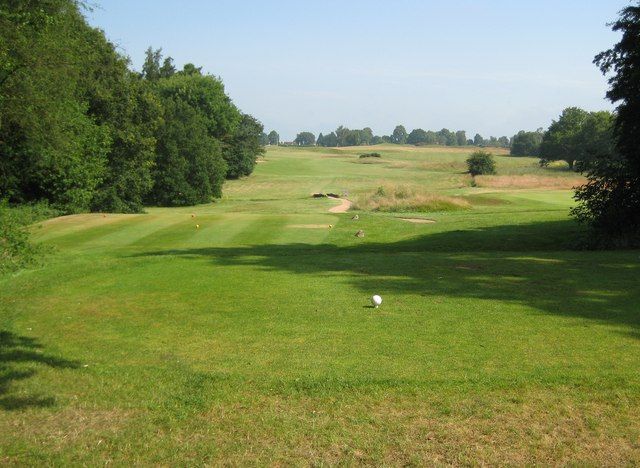
The course opened on Saturday 4 May 1912 with a match between Vardon and the club's new professional, Ted Ray, who won by 4 and 2 while Vardon struggled on the greens.1,26,69 Seven weeks later Ray won the Open Championship at Muirfield.26,27 The scorecard from about 1920 gives 6,539 yards and a bogey of 78, with short holes at the 6th, 11th and 15th.1 Swain's plan labels the same 78 as a standard scratch score (S.S.S.). An account of the course in Sporting Life in March 1927 independently gives the same two figures, 6,539 yards and a standard scratch of 78, and the same three short holes at the 6th, 11th and 15th, which is good confirmation that the card and the plan describe the course as it was actually played.101
The first meetings, 1913 and 1914
The club held its first annual general meeting at the clubhouse on Saturday 17 May 1913, with S. J. Blackwell in the chair, and elected H. H. Cobb captain for 1913 and 1914.26 The secretary's report on the first year listed work on bunkering, fairways, new tees and shelters, and said the greenkeeping expert Peter Lees had been most hopeful about the course and greens when he inspected them.26 Trophies came quickly. A challenge cup for match play singles came from G. Murray Hill, a member of the first committee, an autumn foursomes cup from the directors, a captain's cup from Mr Justice Lush, and a challenge bowl for the lady members from Mrs Walter Blackwell, the ladies' captain for 1912 and 1913.26 The meeting voted to let ladies into the lounge at weekends, then referred the question to all members by circular after an objection that proper notice had not been given.26
The same report noted that the directors were negotiating with the London and North Western Railway for a halt, which the local history sheet also dates to May 1913.26,65 The halt, a wooden one, opened on 1 April 1914 a few hundred yards south-east of the clubhouse, and only certain trains called there during golfing hours, and then on request.26,74,397 At the next annual meeting, on 16 May 1914, the club reported that the halt was working well and would easily pay for itself, that the service would improve once the line was electrified, and that the railway should be asked to stop the 9.35 from Euston there, because many members lived in Hampstead.26 The halt's nameboard read Carpenders Park, for Oxhey Golf Course, and it came down once building of the estate began, as Getting about tells.398
The editor of the transcribed minutes notes that they give capital letters to the Directors and the Secretary but not to the professional or the green-keeper, which he reads as the class feeling of the early club.399
The First World War
Oxhey was due to stage the final rounds of the News of the World Match Play in October 1914, but the war stopped it.81 The minutes follow the war year by year. In May 1915 the secretary reported that five groundsmen and nineteen permanent caddies had joined up, that only three of the original men were left, that the steward had been recalled to Gosport as a Royal Marine reservist, and that about forty members had enlisted while fifty-eight had resigned, eight of them ladies.26 Caddies were taken on only if they were under military age or unfit to serve, and members were asked to make allowances for the course, the caddies and the cooking.26 A fund of £16 had been raised for gardens for the caddies, tools and seed were bought, and after neighbouring chickens and rabbits ate the first sowings the plot was fenced with wire netting, the secretary hoping the lads would leave with useful gardening knowledge.26 The same meeting agreed to suspend for the duration the membership of a man whose nationality was questioned, and to refund his subscription.26
By May 1916 the club had about 78 members on service, had lost 52 members and gained 34 in the year, had waived the men's entrance fee and had set the green fee at 2s 6d on every day of the week.76 Thirty-one groundsmen and permanent caddies were serving, with five casualties among them and nine known casualties among members, and the secretary suggested a permanent record in the clubhouse.76
By May 1917, 84 members were serving in the forces and eight had been killed, and the course was kept by two old hands and four boys.76 One of the old groundsmen had been killed and another was a prisoner of war.76 Sheep helped in some ways, though the lambs damaged the bunkers and the flock drank from the water boxes at the tees.76 A hard winter was expected to improve the drainage after two very wet years, cinders had been spread against the previous year's mud, and no hay was expected because of the sheep.76 The railway refused both better Sunday afternoon trains and Sunday opening of the halt, so the club accepted that it would have to wait, while finding the new electric service useful.76 In 1917 the club reported a fire in the caddie master's and professional's shed, which it had nearly rebuilt by May.76 Ray later wrote that a fire at his Oxhey shop destroyed his wooden clubs, including a favourite driver it took him years to replace, though he gives no date.400 In 1918 wartime farming orders required the club to take cattle as well, and its objection that this would close the course was overruled.77 Members on service paid half subscription that year, which the club credited with holding resignations down to eight.76
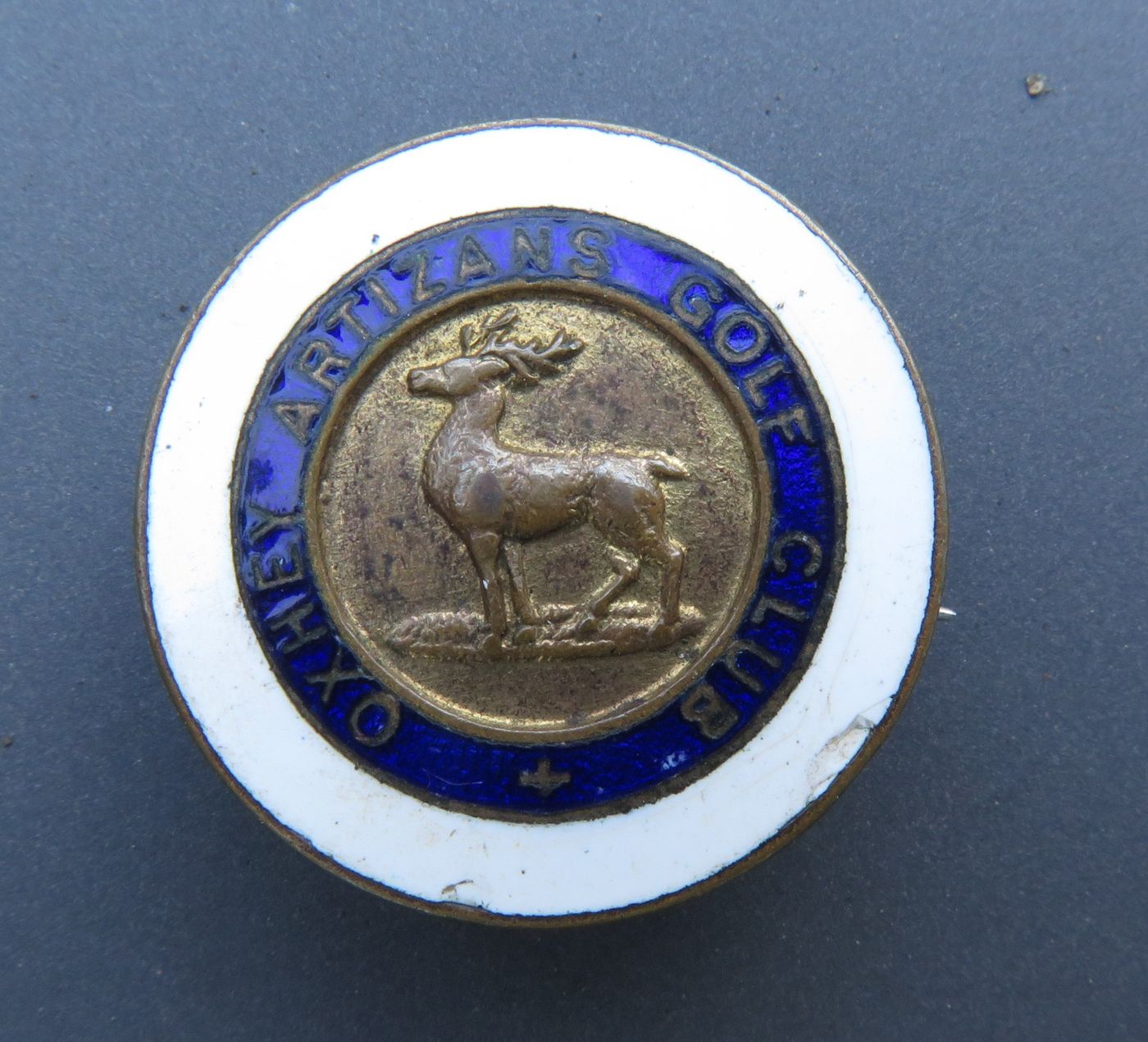
By 1920 the course was in a very poor state after five years of neglected greens and sheep on the fairways.11 That November the club proposed forming an Artisan Club, a section for local working men, partly to cut down trespassing.11 A lapel badge reading Oxhey Artizans Golf Club survives, and another was dug up locally in 1994.1,65 One of them belongs to the local historian Neil Hamilton, who bought it many years ago. It is a small round badge in deep blue and white enamel, with a gilt stag standing in relief at the centre and the club's name running round the ring, artizans spelled with a z.401
The club between the wars
The annual meetings also record the club's own affairs, and three threads run through them. The first is the course itself. In May 1919 the club noted serious waterlogging at the 7th, 8th, 17th and 18th holes, which would need work during the year.11 By May 1920 an Oxhey Golf Course Improvement Fund had been started and killing the worms had become a necessity.11 A severe drought in 1925 hit courses nearby, but careful watering at night saved the Oxhey greens.11 In April 1936 members discussed the nuisance of trespassers and their dogs slowing play.11
The second is the people. In May 1919 the club recorded the need to raise the caddies' pay, and by May 1920 the green-keeper, Sid Baker, had come back from the war very badly damaged.11 In December 1920 the wartime captain, H. Fisher-Smith, was made president in recognition of his service.11 The club's dinner and dance was voted a great success in December 1924, although it later lapsed for want of support.11 In December 1928 the club recorded that a committee member had died suddenly on the course during the year.11 The same meeting heard that the suggestions book was full of complaints about the midday catering, with some members calling 3s 6d expensive.11 In December 1929 Sir Alexander Grant, of McVitie & Price, the biscuit firm that had given its name to a tournament at the club in 1921, presented a cup.11 In April 1934 the chairman put before members an appeal in Golf Illustrated for old clothes and shoes to help the unemployed.11
The third is members and money. By May 1920 membership stood at about 450, and that November the subscription went up from six guineas to ten and the annual meeting moved from May to December, to follow the company's year to the end of September.11 Security of tenure worried the members early, and in December 1921 three pages of the annual meeting went on hopes of it, by way of separate trustees for 50 acres and 100 acres held through the company, leaving the question unresolved.11 Saturday crowding led the club to cap full paying membership at 350 in December 1922, adding twenty ladies and cutting thirty men.11 Kelly's Directory for 1925 dates the club from 1912 and records an 18-hole course two miles from Watford, 475 members, a subscription and an entrance fee of ten guineas each, and S. Jameson as secretary.43 An extraordinary meeting in June 1929, called over a rise in locker rents, was told that a falling membership needed better facilities, and it spent seven pages on whether to improve what the club had or add something new.11
Then money got harder. A deficit of £1,200 in 1930 followed overspending on refurbishing the course, redecorating the clubhouse and staging that year's News of the World tournament, so the directors gave up their debenture interest and asked the committee not to let it happen again.11 In December 1932 membership was 541 after a loss of 42 during the year, and a director told the meeting that payment of the directors' debenture interest was by then several years in arrears.11 By 1933 the directors had given up both their debenture interest and their rent.11 In December 1933 the captain warned members that the directors could not be expected to keep paying for the members' golf, and urged them to recruit.11 Recruiting worked for a while, and in April 1935 the club reported the membership up by 58 during the year, to 529.11
Sid Baker, head greenkeeper
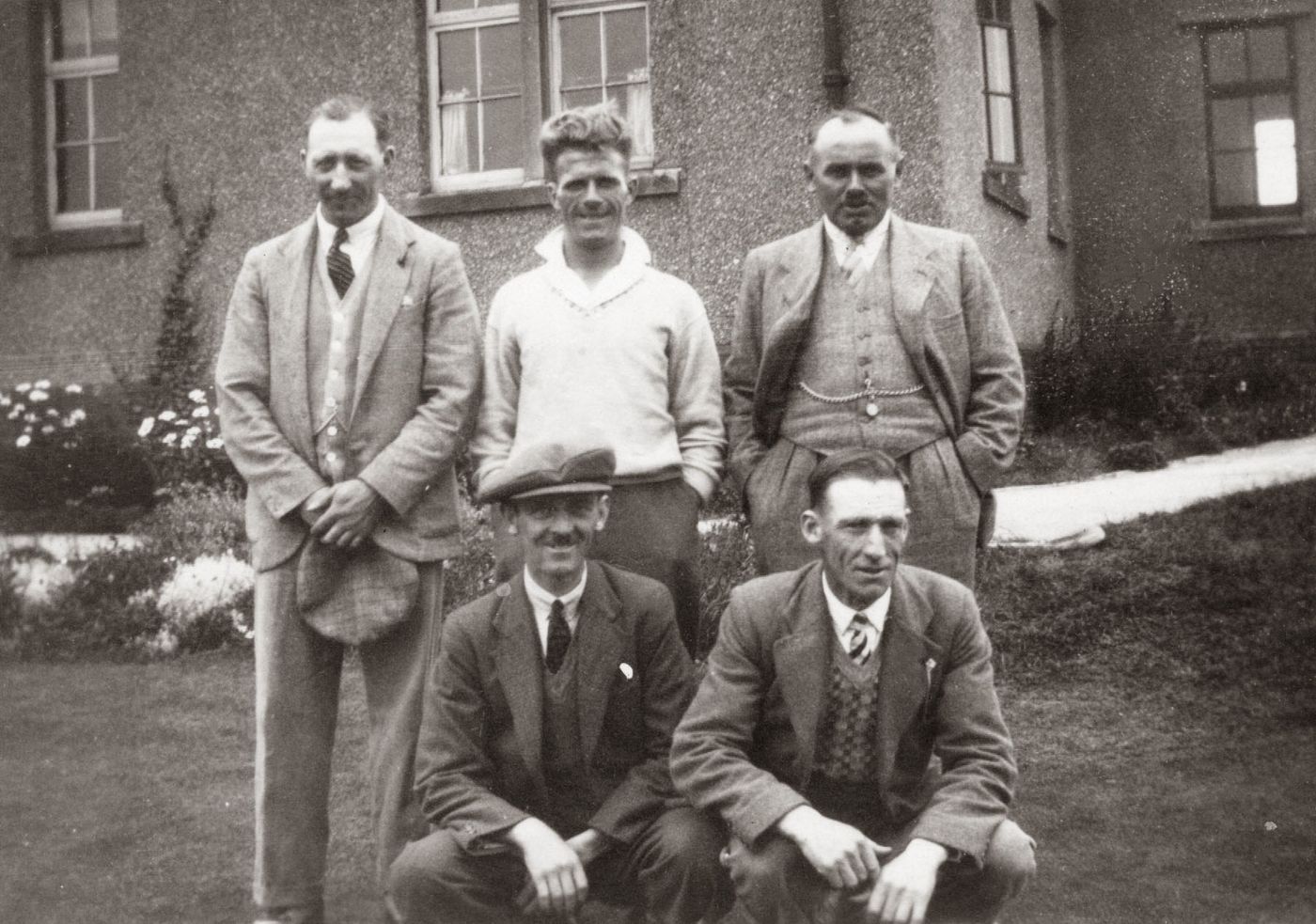
One man looked after this course for most of its life. Sid Baker was born in 1891, went to Callowland School and grew up in north Watford, a few miles from the ground he would spend his working life on.402 He was in his late teens when he joined the work of building the course, stayed through its opening in 1912, and worked up from groundsman to foreman to head greenkeeper, a post he held until he retired in 1951.402 He was there, in other words, for the whole life of Oxhey Golf Club.
He went into the army reserve in 1915 and joined the newly formed Royal Air Force in 1918, only to be invalided out a few months later with a head injury.402 The club minutes record the same thing from the other side: by May 1920 the green-keeper had come back from the war very badly damaged.11,402 He went back to work and stayed another thirty-one years. The wound killed him in the end, three years into his retirement.402 A handwritten note on Don Dunham's own plan of the course gives different dates, 1890 to 1952 and a retirement in 1947, and an older account has Baker serving only until the club closed. The typed notes are the fuller and later statement and this page follows them, but the dates are not settled.1,402
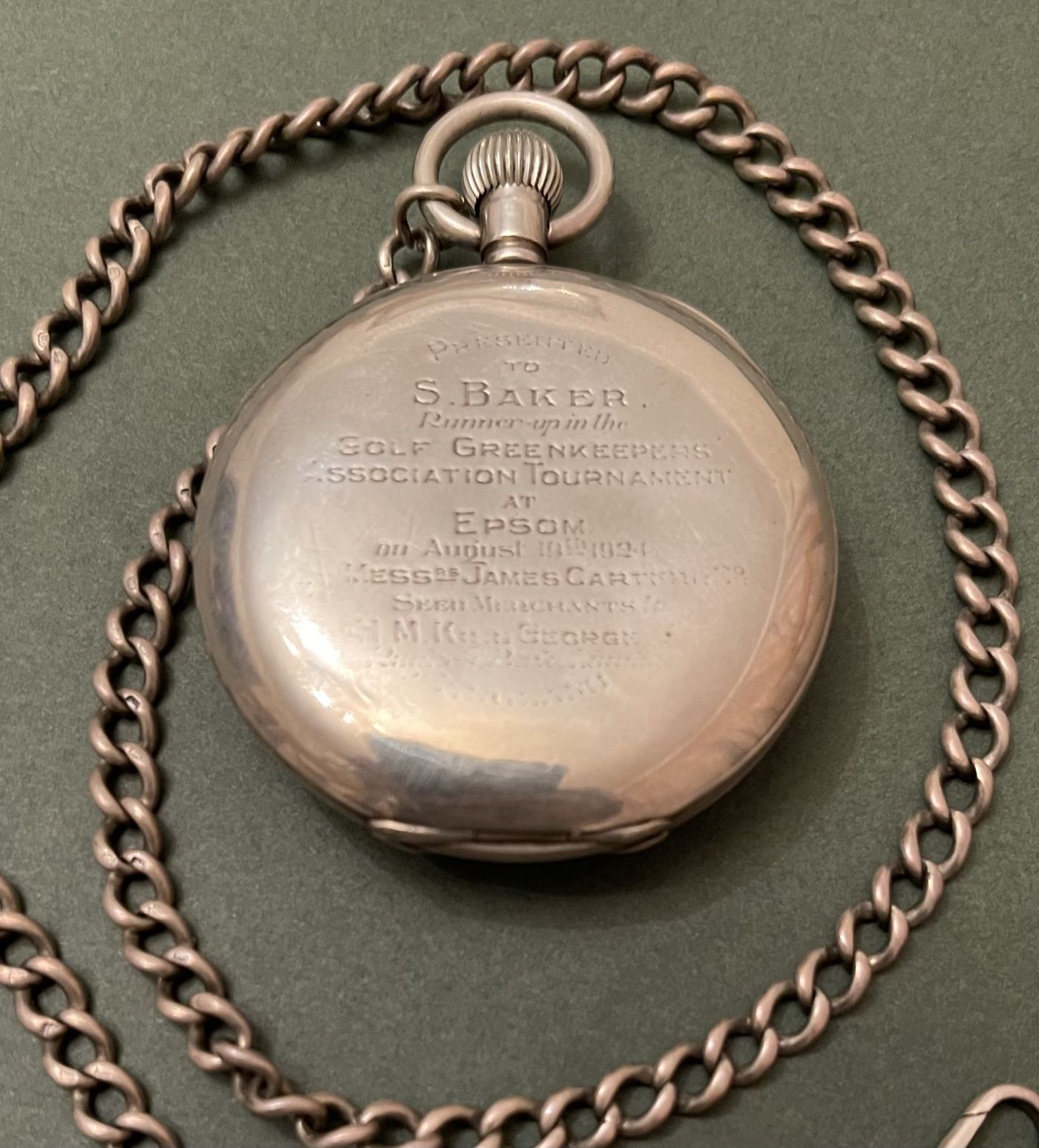
He took his trade seriously. He studied by correspondence after the war, belonged to the greenkeepers' association and wrote for its journal on grasses, fertilisers and the running of a course.402 On 19 August 1924, at Epsom, he was runner-up in the association's own tournament, and the prize was a silver half-hunter pocket watch given by the seed merchants James Carter and Company. He carried it in his waistcoat on its chain for the rest of his life, and his family still has it.402,403 The date comes off the watch, which also calls the body the Golf Greenkeepers' Association where Don Dunham's notes call it the National Greenkeepers' Association; the engraving is the contemporary evidence and this page follows it.403
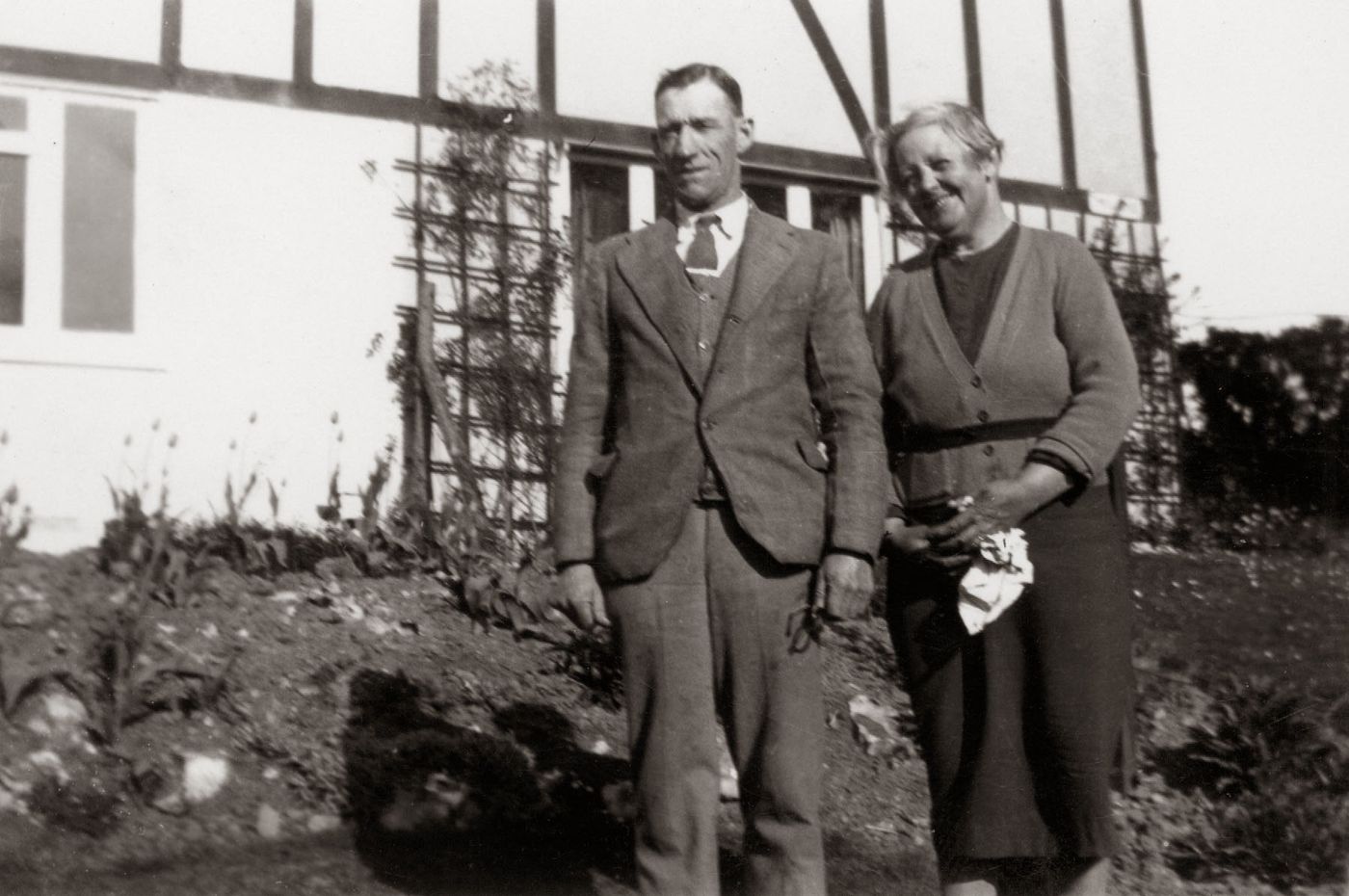
He married in 1913 and had two daughters. His first home was a wooden cottage on the bend of Hampermill Lane, opposite Hampermill, thought to have been a tied cottage of the Blackwell estate and old enough to appear on an eighteenth-century map; it came down about 1925 to make way for housing.402 He moved later to a house called Braeside further along the same lane, backing on to Hampermill Wood and the top of the course near the fifth green.402 Don Dunham's notes read as though he moved when the cottage came down, but John Swain, who went over it with him in 2004, gives the house as dating from 1929, and Dunham's own plan of the course marks it as the greenkeeper's house in that year.289,402,404 Where the family were for the four years in between, nobody has said. His grandson Don Dunham wrote all this down in May 2004, and it is to him that this site owes most of what it knows about both Baker and Ted Ray.402
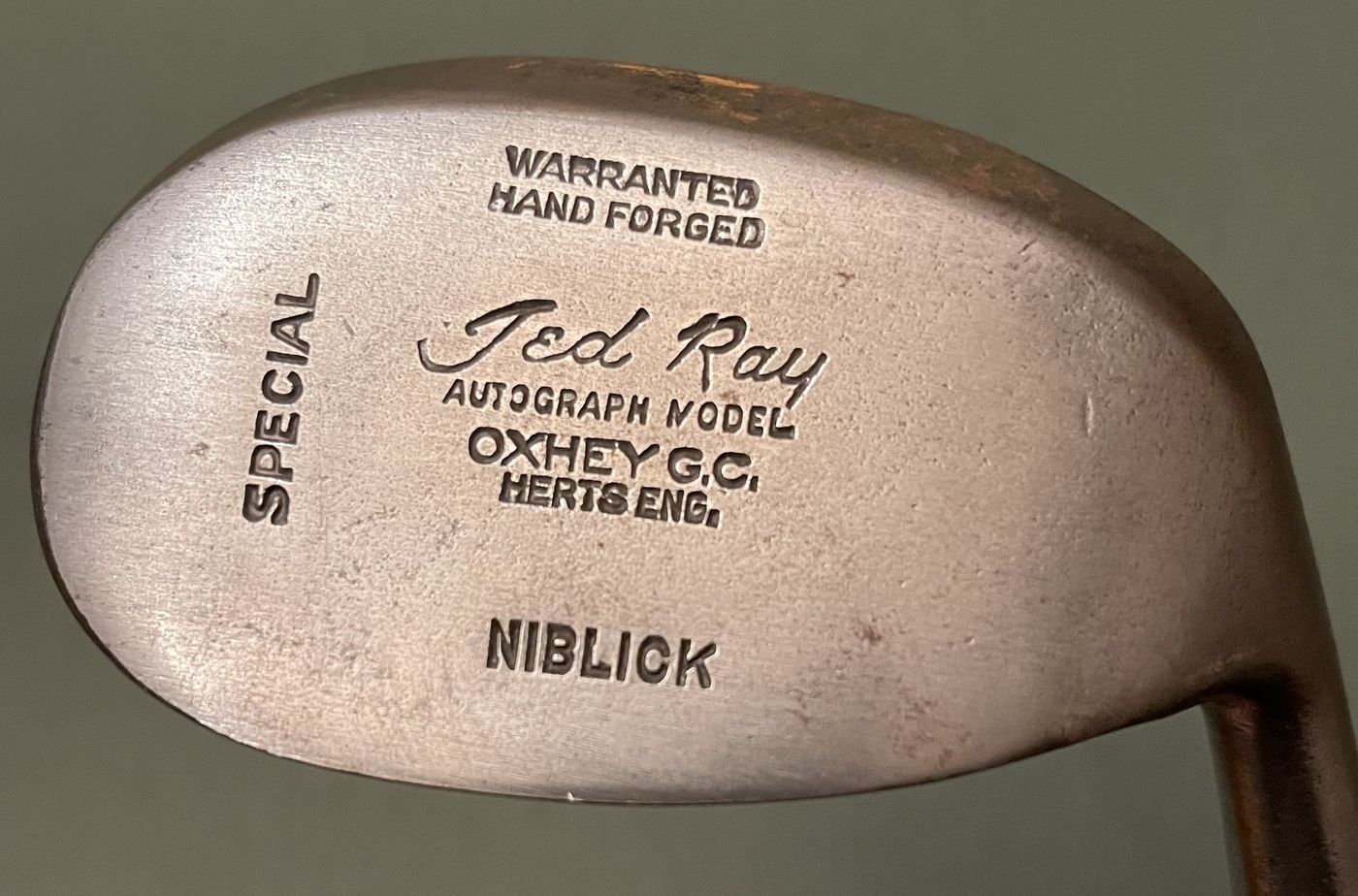
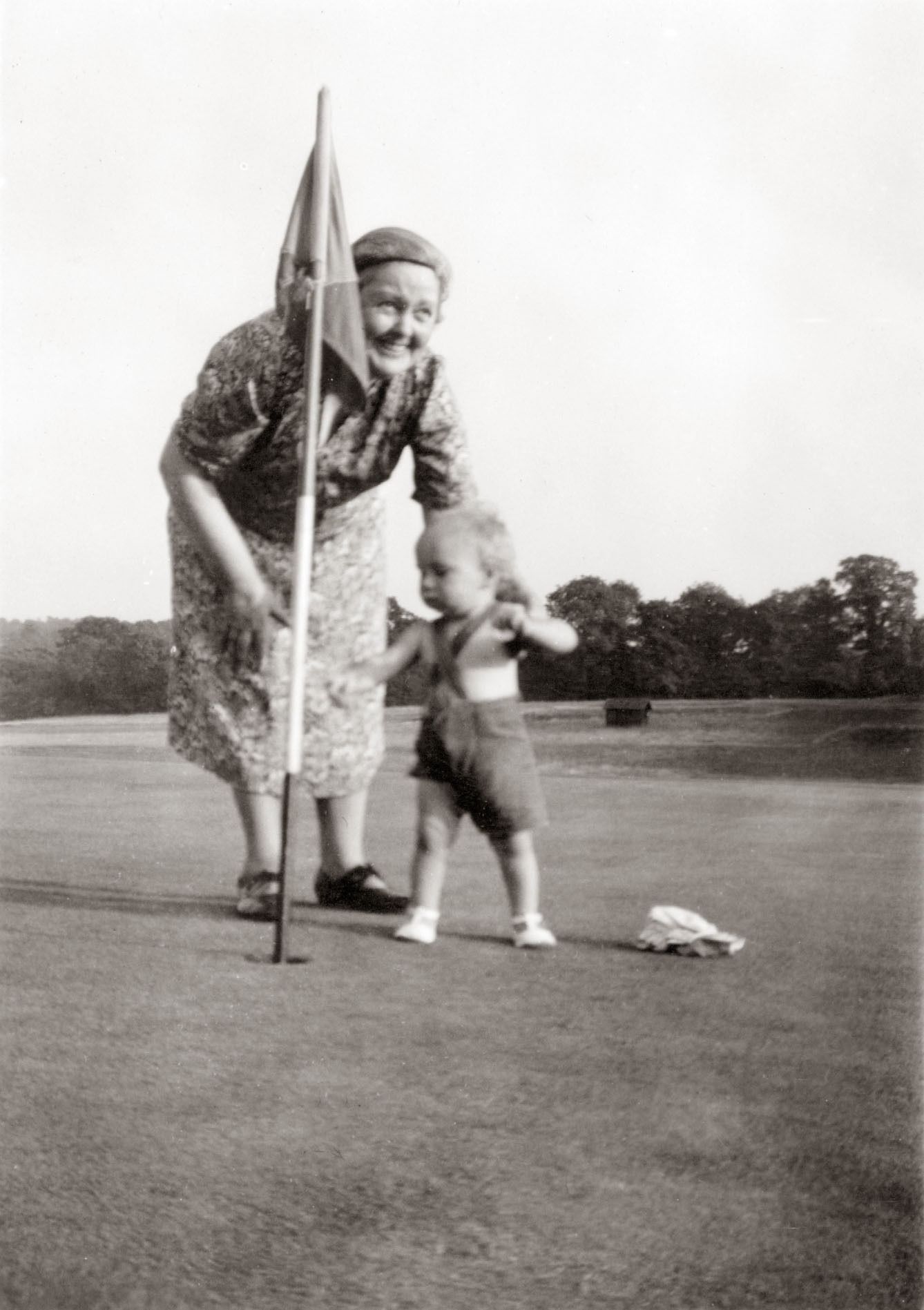
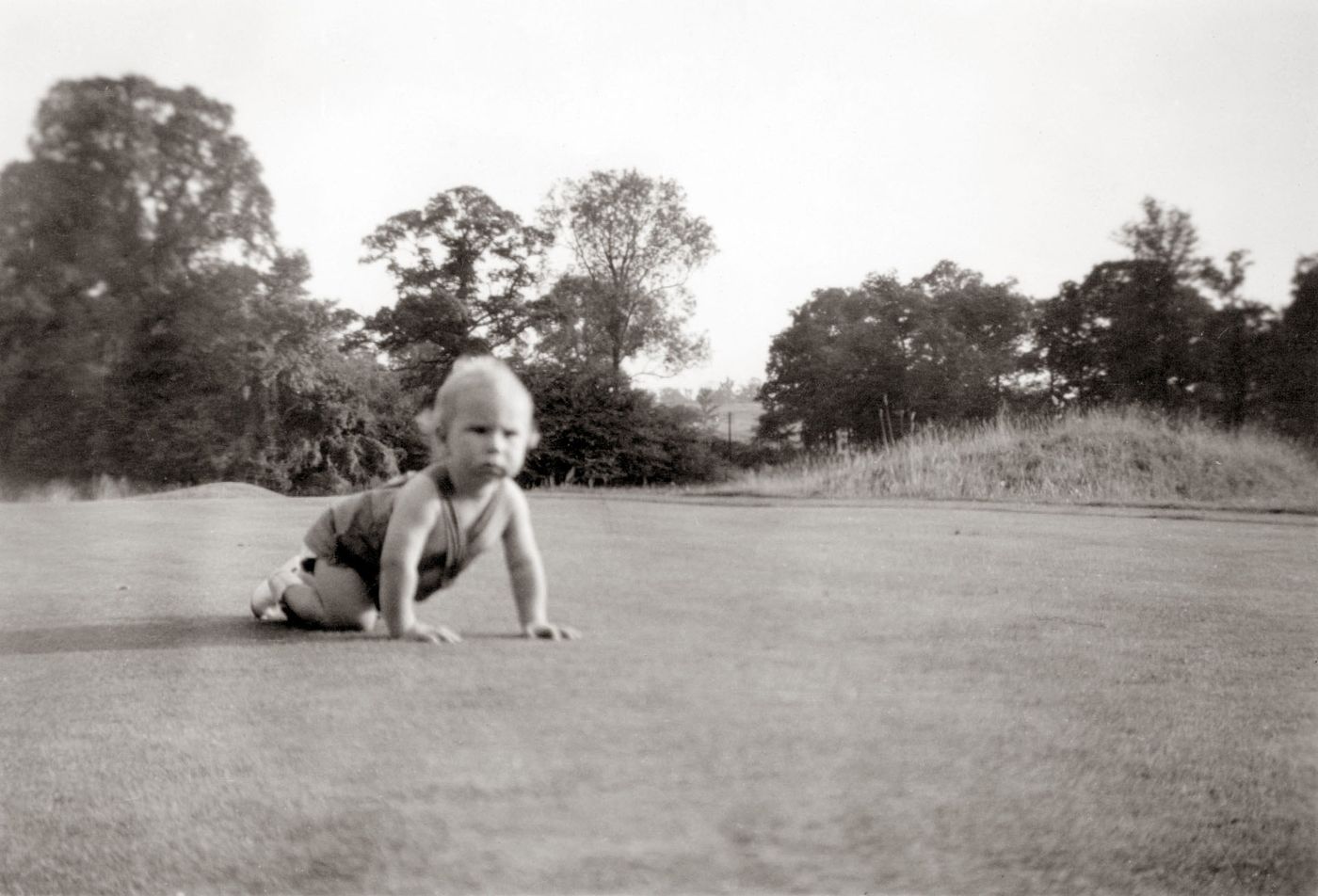
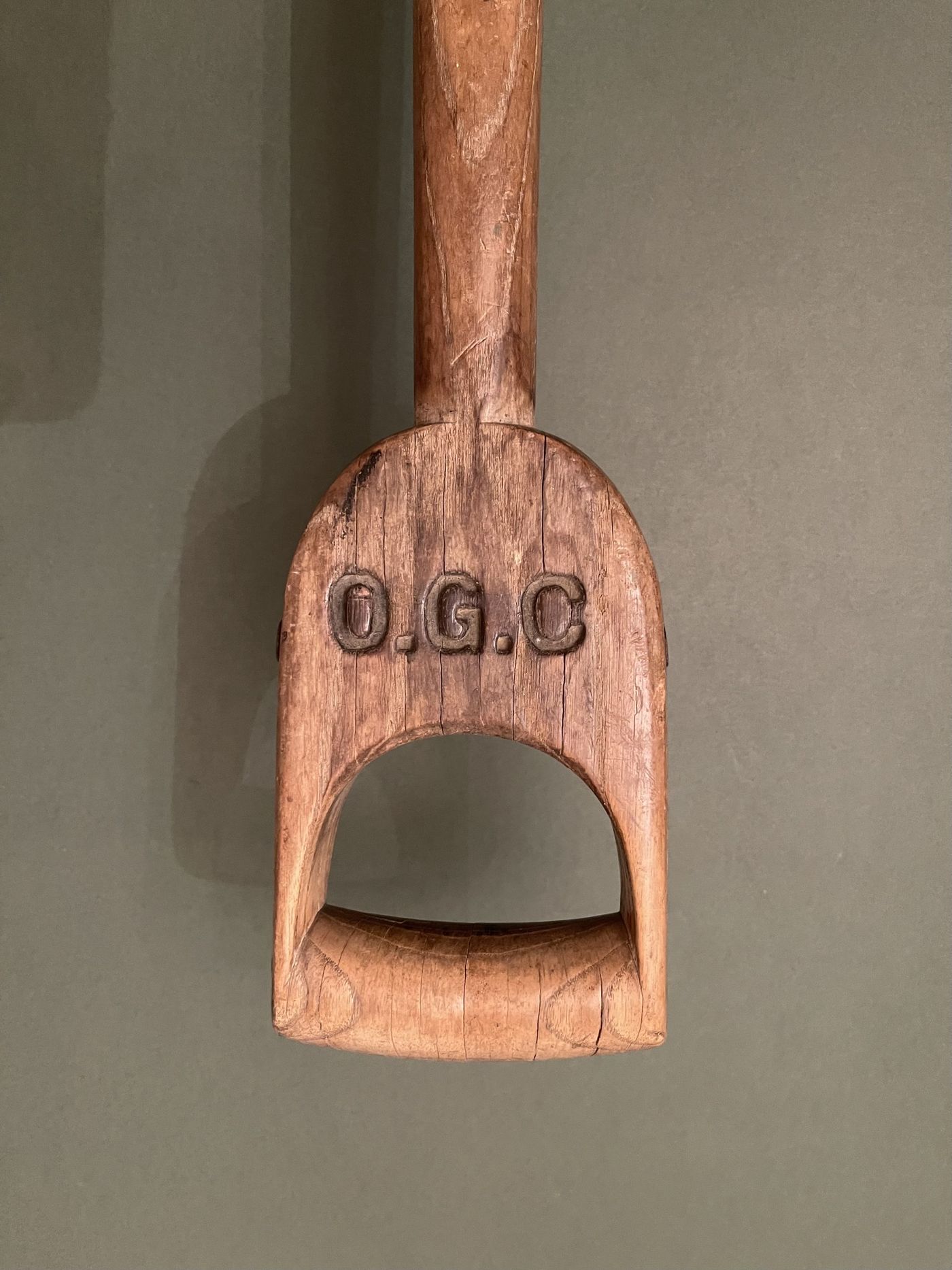
Three things of his and the club's have come down through the family, and they are worth more than their size.405 There is a greenkeeping tool with O.G.C. burned into the handle, so that it could not walk off the course. There is a hickory-shafted niblick stamped with Ted Ray's facsimile signature, the words autograph model, and the club's own address, Oxhey G.C., Herts Eng., which is a reminder that Ray sold clubs at Oxhey as well as playing there.405 And there are family photographs taken on the course itself: Ava Baker holding the pin on a green while a small boy reaches up at it, and a baby crawling across the close-mown grass with the lip of a bunker behind.405 The greenkeeper's family had the run of the place.
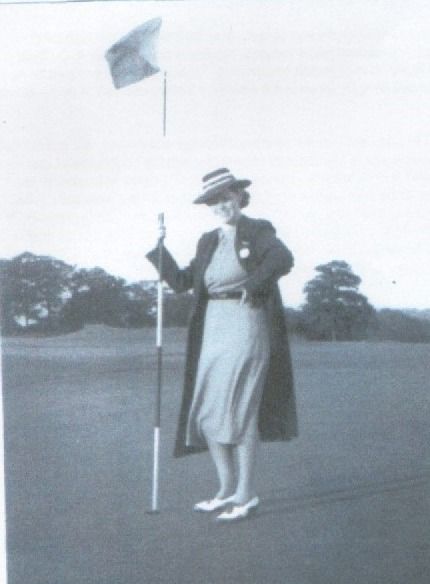
There is one more of them, and it is the best. In the summer of 1938 his daughter Elsie was photographed on the fifth green in a straw boater and a long coat over a summer dress, holding the flagstick upright like a staff, with the trees of the top of the course behind her.406 She married into the Dunham family, and it was her son Don who sat down in 2004 and wrote out everything his grandfather had told him.402,406 Nearly everything on this page about Sid Baker and about Ted Ray comes, in the end, from the woman holding that flag.
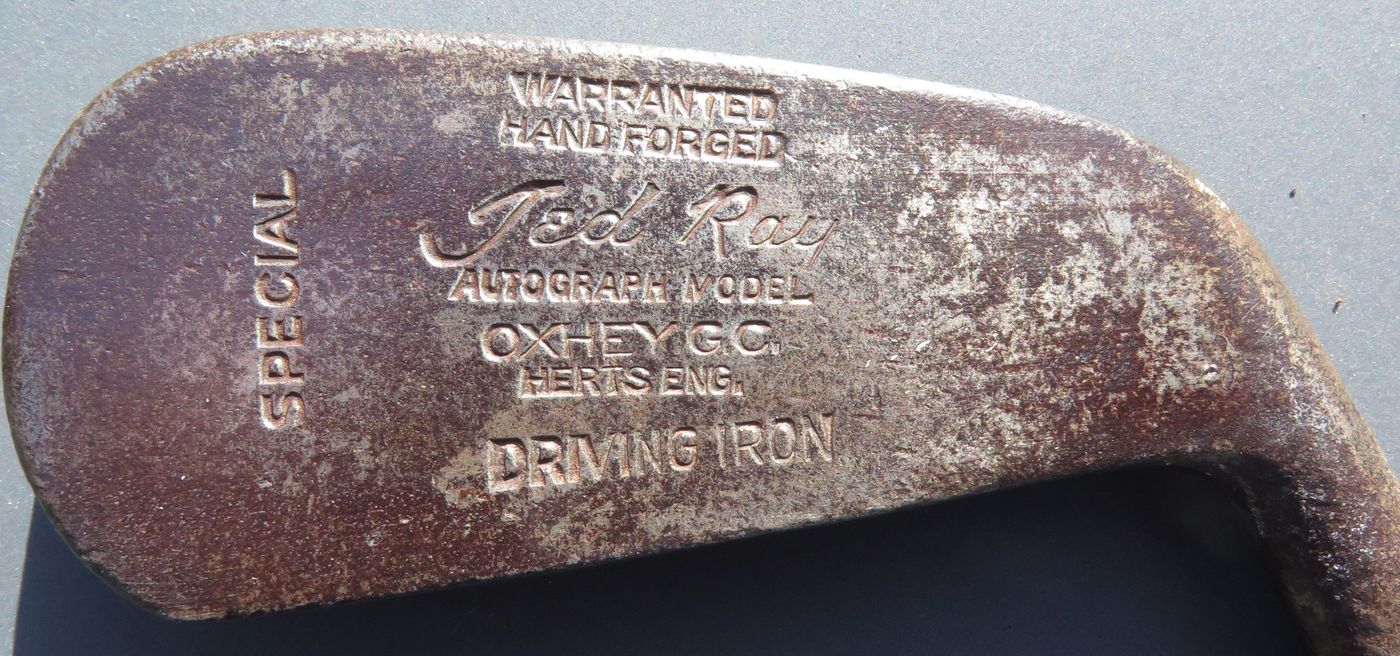
The niblick was not a one-off. Neil Hamilton bought a driving iron years ago, quite separately and from quite another direction, and it carries the same stamping: warranted, hand forged, the facsimile Ted Ray, autograph model, Oxhey G.C., Herts Eng., with the word special down the toe.401 Two clubs of the same make, surviving in two families with no connection to each other, say more than one would. Ray was not simply the club's professional. He had a shop on the premises selling irons with his own name on them, and ninety years after it closed the stock is still turning up.
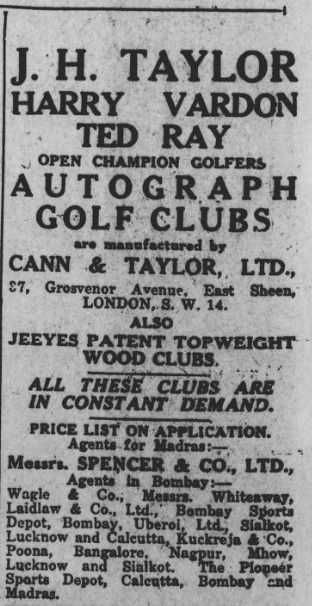
A press advertisement in the same collection says who was actually making them. Autograph clubs carrying the signatures of J. H. Taylor, Harry Vardon and Ted Ray, the three open champions, were manufactured by Cann and Taylor Ltd of 87 Grosvenor Avenue, East Sheen, which was Taylor's own firm, and sold through agents in Madras, Bombay, Poona, Bangalore, Nagpur, Lucknow, Sialkot and Calcutta.407 Neil Hamilton has it as a cutting from the Times of India. The cutting itself carries no date.407 So the irons in these two Hertfordshire families came off a production line that was supplying the subcontinent, and somebody at Oxhey ordered them with the club's own address added to the stamp.
The club in 1927
In March 1927 Sporting Life devoted two columns to Oxhey under the heading "A course for big hitters", and it is the fullest contemporary description of the club that has come to light.10 It found a club of 375 full members, no fewer than six of them Blackwells, with L. W. Sedgwick as president and J. H. Blackwood as captain.10 Kelly's Directory had given 475 members two years earlier, so either the club had shrunk or, more likely, the two counts were not counting the same thing.10,43
The paper named those it thought had done most for the club: S. J. Blackwell, a founder and its first president, Sedgwick, H. G. Marshall, D. C. Rutherford, A. E. Phelps, Blackwood, H. H. Cobb, H. F. Lye, H. M. Orr, Sir C. M. Lush, H. Fisher Smith, "and the late Sutherland Jameson, the first secretary, who died in 1926".10 It says elsewhere in the same piece that Jameson had been secretary for six years, which does not sit easily with his being the first in a club founded in 1912, so one of the two is loose.10 He was certainly the secretary Kelly's listed in 1925, and he lived at Tyndrum in Green Lane.10,43 His successor was Major F. A. Stephens, DSO, a scratch or better player for thirty-eight years who had twice won the Dorset championship.10
The club played matches against the Oxford and Cambridge Golf Society, the Parliamentary Golf Club, the Moles, Moor Park, Porters Park and Berkhamsted, and was "difficult to overcome" at full strength.10
The club in 1932
Five years later The Tatler gave Oxhey a whole page of caricatures, the second in a series called Golf Clubs and Golfers, on 15 June 1932.408 It is the only group portrait of the membership anyone has produced, and it names fifteen of them.408 Mark Pooles was captain of the club and D. C. Rutherford a past captain, Major F. A. Stephens was secretary, Dr J. C. Ashton sat on the house committee, and Mrs Russell Smith was lady captain.408 Then John Cowan, A. I'ons, H. W. Beveridge, K. Costley White, R. Egerton Johnson, the ex-captain A. E. Phelps noted for his short approaches, and a two-handicap man called Ginger Darke, drawn as one of the lads of the village.408 Ted Ray is there with his pipe, in what the magazine calls a most characteristic attitude, and so is his assistant professional, Frank Forge, whose name no other source here gives.408

The fifteenth is the best of them. C. E. Ruault is drawn walking, captioned late with his cuts and always late on the first tee, and vice-president of the Frogs Cricket Club.408 Nobody writes that about a man he has not played with.408 Four of those names, Rutherford, Phelps, Stephens and Beveridge, had already appeared in the Sporting Life piece of 1927, which is a useful check on both.10,408
H. W. Beveridge, who held the amateur record, is drawn with a note of his form: a handicap of plus one, played for Oxford in 1900, 1901 and 1902, and formerly plus six at Deal.408 Major F. A. Stephens was still secretary six years after taking over from Jameson.10,408 Membership had risen to about 560, against the 375 full members of 1927, and the magazine recommended the club to Londoners on the grounds that Carpenders Park was only some fourteen miles out with a good train service.408
It also records something about Ray that no other source here does: that he had won the Hertfordshire Championship the previous year, 1931, for the seventh time.408 The artist drew him, the caption says, in a most characteristic attitude.408
The records, and Ray's 65
In 1927 the standard scratch score was 78, the amateur record 72 by Beveridge, and the professional record 71 by J. H. Taylor.10 Golf's Missing Links gives those last two as 1930 figures, so the cutting shows both were already standing three years earlier.1,10 What the paper says next is the striking part: Taylor's 71 "has been beaten on several occasions by Ted Ray, whose best return is 65".10 The club professional's own rounds plainly did not count as records, or Ray would have held it outright. The recognised figures came down later, to 70 for the amateurs C. W. Measor and R. D. Blackwell and 68 for the professional S. L. King, and both of those are still well above the 65 Ray had already gone round in.1
The ladies' section
The same account gives the ladies' section its own space, which no other source on this site does.10 Their course measured 5,371 yards with a par of 78 under the Ladies' Golf Union, and the paper called the section particularly strong.10 The captain was Mrs H. N. Balfour, who was also captain of the Hertfordshire ladies' team; the secretary was Miss Mary Swanston, a previous winner of the Blackwell Bowl; and Mrs E. J. McNair and Mrs Fleming were among the best players.10 Past lady captains included Mrs Oliver Oldham, Mrs T. W. Eden, Mrs E. P. Biggs, who held the office for four years, Mrs E. E. Willis, Miss E. St. G. Hewson and Miss A. Kidman.10
The great days
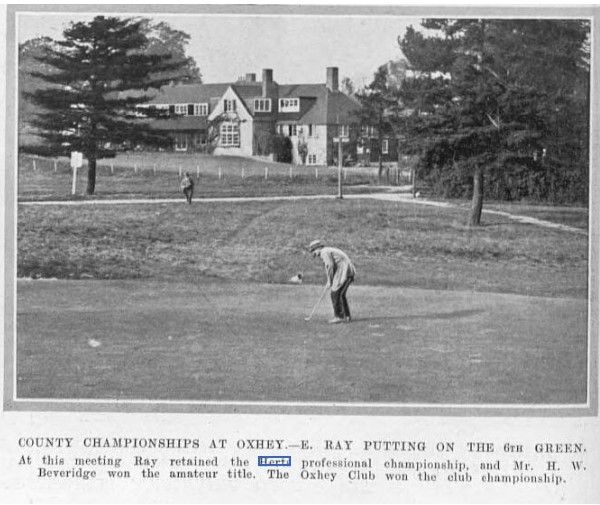
In 1921 Oxhey hosted the McVitie & Price Tournament, won by Abe Mitchell, and the News of the World final, where Bert Seymour beat Jack Gaudin at the 40th hole.80,81 Gaudin had knocked out Ted Ray the day before.1
On 16 April 1923 fourteen leading professionals, captained by J. H. Taylor, played the Stage Golfing Society at Oxhey and won by 11 matches to 3. Ray won his game 5 and 4, but the actor G. Tearle beat Harry Vardon 3 and 2.1 A Pathé newsreel of 1923 shows the stage stars Leslie Henson and Jack Buchanan playing here.409 That April the course also staged the Golf Illustrated Gold Vase, won by Cyril Tolley.1,69
The club called 1928 a successful year. Its captain was Hertfordshire champion and its professional was Hertfordshire professional champion, and the two of them won the County Flag together, while the club team won the Inter-Club Team Championship.11
In June 1929 members argued over a rise in locker rents to help pay for an extra nine-hole course. By December 1930 this short course cost 2s 6d a day, and members' children aged 8 to 18 could play it on weekdays for a guinea a year.11 Directories of the mid-1930s list Oxhey with both an 18-hole and a 9-hole course, but no source says where the short course lay.1
In 1930, possibly just after he won the Open, the American amateur Bobby Jones played a charity four-ball at Oxhey shortly before sailing home.1,84 A press report from an unnamed paper says about 2,000 people watched Jones and James Braid beat Harry Vardon and Ted Ray by 4 and 3.1 That September Charles Whitcombe beat Henry Cotton in the News of the World final.81
In October 1931 Oxhey staged the first women's international between Great Britain and France, the start of the Vagliano Trophy, and the British side, with Joyce Wethered, won by 8½ matches to ½.1,85 In 1936 Dai Rees came back from five down to win the News of the World final by one hole.81
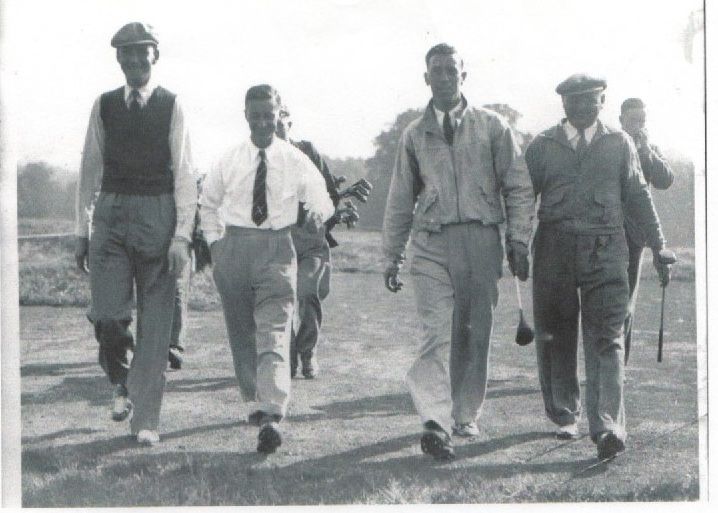
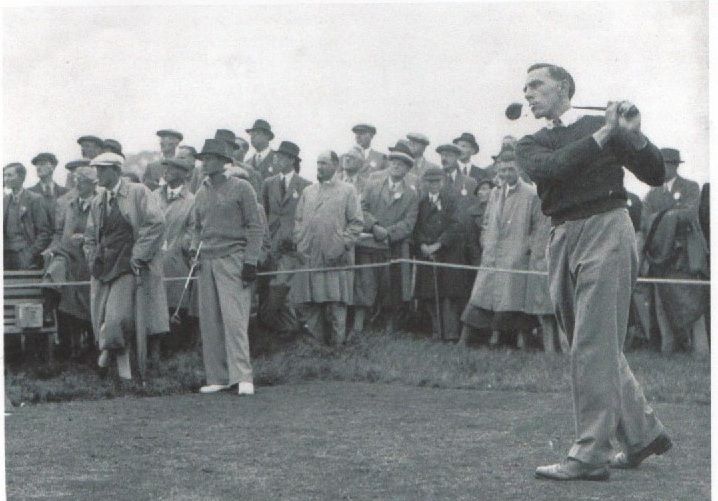
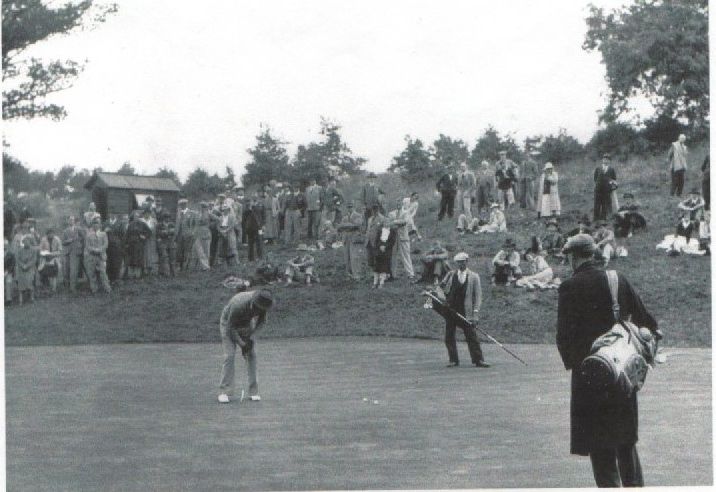
Three photographs survive from that week, kept by Don Dunham and originally attributed to the London News Agency.410 They are the only known pictures of a crowd on this course. One shows players walking up the third fairway, along the line of what is now Ashburnham Drive, with Big Wood on the skyline; John Swain takes the tall man second from the right to be Alf Padgham, who had won the Open at Hoylake that July.410 A second has a golfer driving in front of a deep gallery of men in caps and trilbies, whom Swain identifies as Sam King.410 The third looks across the ninth green, the 110-yard short hole, with the spectators banked up the slope behind it and a small wooden refreshment hut among them, the only sight of that building anywhere.410
The 1936 re-routing
The club minutes first suggested reordering the holes in 1921, fifteen years before it happened. By the mid-1930s a line of pylons ran along the east side of the course, and a local rule let a ball that struck a cable be played again.7
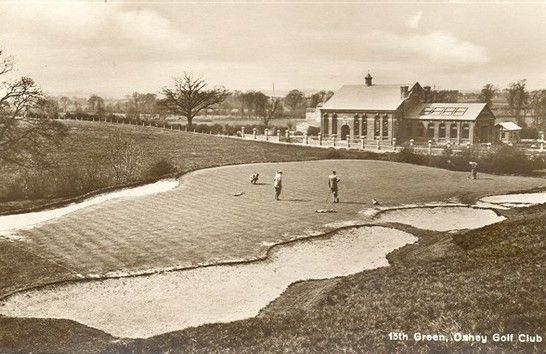
For the 1936 season the holes were renumbered to balance the two halves of the round.1,2 Bernard Darwin, writing in about 1937, says the old 7th became the 1st and so on, so the old 1st became the 13th.1 John Swain posted two versions of a note on this, one saying the new 2nd was the old 2nd and one saying the old 8th.2 Darwin's rule and the 447 yards on both cards point to the old 8th.1 A later card gives 6,405 yards and a standard scratch score of 75.1 This guide uses the numbers from before 1936, as on Swain's plan.
The Second World War
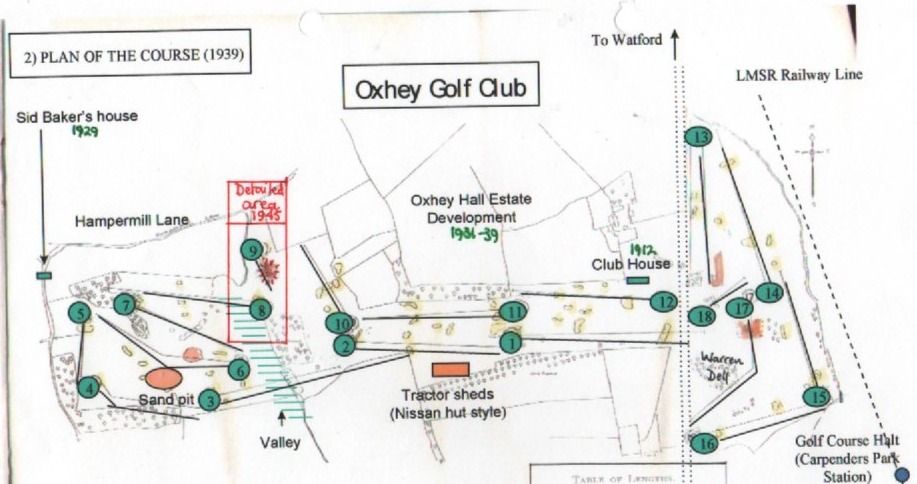
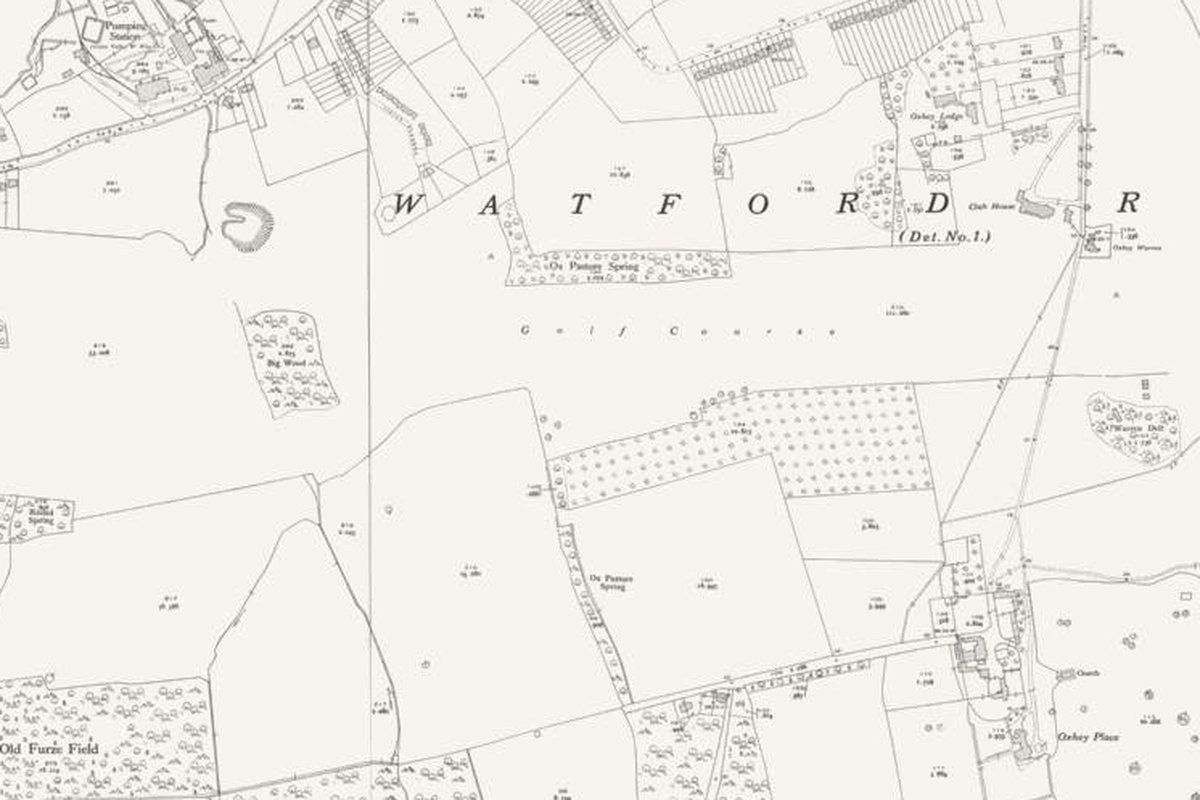
Don Dunham traced the course off the map in the club's own brochure, and he and John Swain marked it up between them, so the plan shows Oxhey as it stood in 1939.404 All eighteen greens are numbered on it. The clubhouse of 1912 sits near the middle, the railway and the Golf Course Halt at Carpenders Park run down the right-hand side, Hampermill Lane crosses the top left with the greenkeeper's house marked on it, and along the north edge is the Oxhey Hall estate, the housing already arriving at the boundary.404 The pencil note beside it reads 1934 to 1939, but Swain has been back to his own copy and gives the estate's dates as 1931 to 1939.289,404 The first houses went up in Oaklands Avenue and Raglan Gardens, the lower part of Vivian Gardens followed from 1933, and the last road to be laid out was Hillcroft Crescent, though parts of Vivian Close may not have been finished until after the war.289 Swain met a resident of 87 at the Vivian Close and Vivian Gardens junction in July 2024 whose house was built in 1935.289 The sand pit, the valley, Warren Dell and the tractor sheds, noted as Nissen hut style, are all on it too.404 Swain's own reason for drawing it to attention is that it lets you follow the re-routing of the course from 1936.404
The brochure the plan was traced from had a famous writer in it. The notes were by Bernard Darwin, golf correspondent of The Times and the best known golf writer of his day, and he wrote them in 1937.411 What he says about the view from the top of the course is worth having, because it catches the estate arriving. The ground is still, he writes, "big, green, wooded and countrified", but there are already "rather too many red roofs in one direction".411 The red roofs are Oxhey Hall. Fifteen years after he wrote that, the whole of the rest of it was a council estate too.
At the annual meeting of 29 April 1939 the club reported that T. A. W. Blackwell was now sole owner, that the lease had only until September 1942 to run, that efforts to extend it had failed because of conditions at the time, and that membership had fallen as members cut their spending.3 A trench shelter was dug near the clubhouse before the war began.7 In the war most serious golf stopped, membership fell, and sheep grazed the course to save on upkeep.7
Even so, in April 1940 the course was reported to be in excellent condition, with economies made.3 A resident remembers walking from the station to the clubhouse about 1940 by a flight of steps, two kissing gates, the cattle tunnel and Blackwell House, and says the army set up a searchlight base beside that track, to go with the anti-aircraft guns at Highfields in Oxhey Lane.412 A photograph of 1940 shows the Oxhey branch of the Air Raid Precautions wardens, whose work included getting people to shelter, calling fire engines and ambulances, checking for casualties and looking for unexploded bombs, with a warden for each street.413 At its April 1940 meeting the club marked Ray's retirement after 28 years as its professional, though two sources, the club's secretary C. K. Cotton and Ray's previous club Ganton, give 1941.3,91,92 Cotton was still signing the club's notices to members in November 1942.414
In 1941 the landowner, T. A. W. (Anthony) Blackwell, proposed running the club himself, because he did not want houses built on the course and saw it as "an amenity to his house".3,88 At a meeting on 20 September 1941, the club put its capital at £1,500 in shares and £16,200 in debentures, nearly all of it held by him, and proposed surrendering the last year of the lease so that he took the directors' place, which would let three quarters of any loss be passed to the government.3 Anthony Blackwell was killed on active service on 5 July 1942, and in 1943 the members met to decide whether the club could go on.3,88 The transcript of the minutes calls the owner killed with the Royal Artillery that day R. A. W. Blackwell, where the club's own 1939 report and other sources give T. A. W.3 That meeting, on 28 February 1943 and chaired by H. W. Dallas, was to decide whether the club should exist after 1 May 1944, and members hoped the executors would grant a lease.3 Two months later a committee member had to resign because of the petrol restrictions.3
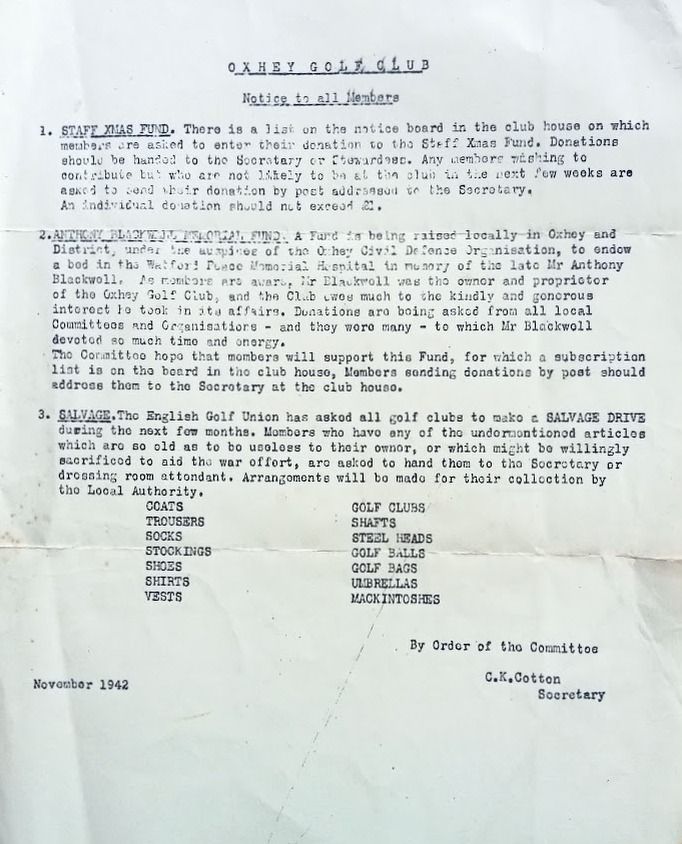
One sheet of club paper survives from the middle of all this, and it is the plainest picture of Oxhey at war that this site has.414 It is a typed notice to all members, dated November 1942 and signed by the secretary, C. K. Cotton, and it carries three items.414 The first asks members to put their names on the list in the clubhouse for the staff Christmas fund, to hand the money to the secretary or the stewardess, and not to give more than a pound each.414 The second asks them to support a fund being raised across Oxhey and district, under the Oxhey Civil Defence Organisation, to endow a bed at the Watford Peace Memorial Hospital in memory of Anthony Blackwell, who had been killed four months earlier.3,414 The notice calls him the owner and proprietor of the club, says the club owed much to the kindly and generous interest he took in its affairs, and notes that donations were being asked of all the local committees and organisations to which he had given his time, and that they were many.414
The third item is the one that stops you. The English Golf Union had asked every golf club in the country to run a salvage drive, and Oxhey's members were to hand in anything too old to be of use to them, or that they were willing to give up for the war effort, to the secretary or the dressing room attendant, for the local authority to collect.414 The list is printed in two columns: coats, trousers, socks, stockings, shoes, shirts and vests on the left, and on the right golf clubs, shafts, steel heads, golf balls, golf bags, umbrellas and mackintoshes.414 A club that had been laying out money on Vardon's design thirty years before was now being asked to break up its members' spare irons for scrap. It is worth remembering that when you look at the two clubs further up this page that did survive.
By 1944 the Oxhey Air Raid Precautions service had asked to use the clubhouse Ladies' Room at night for its mobile ambulance unit.3 John Swain says German bombs fell on the course and nearby woods, and some craters became small ponds that children from the estate enjoyed.12
In August 1945 the greens committee planned to grass over up to half the bunkers to cut costs.1 At the annual meeting of April 1946 a member said it must have been heartbreaking for the head green-keeper to be unable to get worm-killer or dressing, or anything to counter the effect of the sheep.3 The transcript of the minutes dates that meeting 1945, but it already has the 1945 meeting on 28 April, so 1946 is almost certainly right.3 The committee's report for 1945 and 1946 set out scarce labour, formidable catering problems caused by rationing and the uncertainty caused by the council, but held that the club should carry on, and the executors allowed the existing arrangements to run another year.3
The end of the club
After a public inquiry at Watford Town Hall in April 1944, the Minister of Health let the London County Council (LCC) buy a little over 921 acres of the Oxhey Place estate for a new housing estate.4,31 The 1943 Housing Order tells that story.
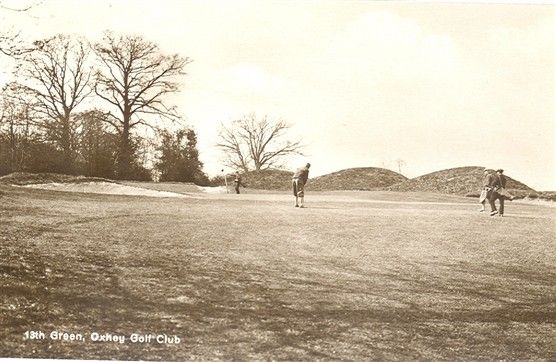
In August 1946 the club heard that the LCC's new road on its north-east edge would take the 13th green and the 14th and 15th holes, numbered after 1936 (the old 1st, 2nd and 3rd).3 Members would only carry on with a lease of at least 15 years.3,12 A council letter of 2 September, read to the committee on 7 September, said the road along the eastern boundary could not be re-sited, that land marked pink and hatched red was needed within the week, and that further land marked pink was needed by 1 November.3 At the same meeting the club read a letter from the Hertfordshire War Agricultural Committee saying it would be asked to allow sheep to graze the course through the 1947 season, and thought about appealing.3 It was the failure to get a long lease from Hertfordshire County Council that led the committee, on 21 September 1946, to propose closing on 31 October.3 With none on offer, the private club closed that day.3,12 Building of the estate had begun that month, using London bomb rubble as hardcore.23 In January 1947 the club's equipment and furniture were advertised for sale, from twelve hand mowers and two tractors to 64 oak chairs.1
In April 1947 the course reopened as a public course run by Watford Rural District Council, shortened to 5,602 yards.1,12,69 A card from a round played in October 1949 gives the shortened course a standard scratch score of 73.1 The round was Eric Holt's, and the card was printed in the Watford Observer.9 It is cited on six of the hole pages here, because the lengths on it can be matched against both the earlier cards and so show which holes were still in play at the end.9 Children from the new estate waited in a big orchard on the left as you walked up the course towards Sandy Lane, picked up the drives that landed there and sold the balls back to the golfers, who knew quite well what they were doing.416 In January 1952 a newspaper report said Watford Rural Council had told members it would not carry the course on, and that the clubhouse would probably become a community centre.1 The same report noted that the professional, Frank Forge, who had come to Oxhey with Ted Ray when it opened, would have completed forty years' service on 15 April.1 He is on the Tatler page of 1932 as well, drawn walking with a club over his shoulder and captioned simply assistant professional, so the man who finished as the municipal course's professional had arrived with Ray in 1912 and was still there when the ground became playing fields.1,408 The course lost money and closed on 31 March 1952, five weeks short of the course's fortieth birthday, and the ground became South Oxhey Playing Fields.1,12 An Oxhey Nomads Golfing Society was formed after the private club closed to keep former members of the club together, and it lasted until the early 1970s.399
How the public course was laid out is known at all because of one man's legwork. The course was re-routed in 1936 and altered again after the war, and by the time anybody came to write it down there were very few golfers left who had played the municipal course in the 1940s.417 Brian Helbrough, who died in 2022, went round the local clubs interviewing players who had known it, and from what they told him worked out the likely post-war layout.417 John Swain then drew the changes as a sketch map, which was printed in Poor But Proud at page 70 and checked against Eric Holt's card.9,417 Swain says that when he began on the club in 2003 he had no idea the layout had ever changed.417 Every hole page on this site is numbered on the c.1920 card for that reason, and says what each hole became.
The clubhouse after golf
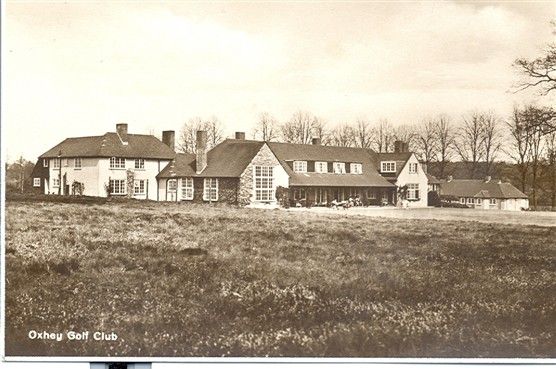
The clubhouse still stands on Green Lane.8,418 The playing fields tells what became of it.