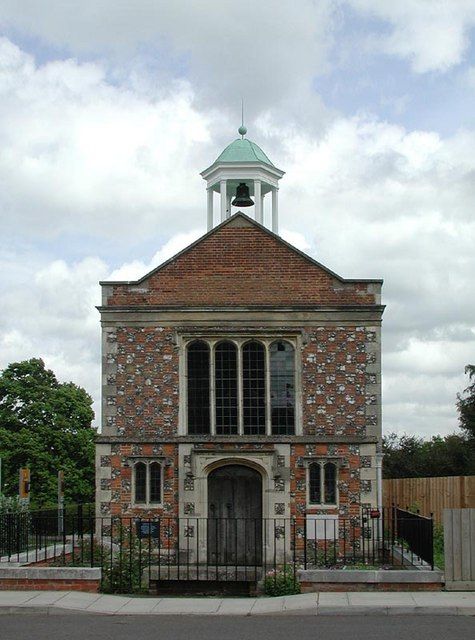
Oxhey Chapel in Gosforth Lane is the oldest building on the estate. Sir James Altham built it in 1612 as the private chapel of his house, and it survived the loss of that house, years as a lumber store, the building of a new town around it and a roof that partly gave way under snow.18,19,114 Today the Churches Conservation Trust looks after it, and it is listed Grade II*.19,317
Sir James Altham's chapel
James Altham, a lawyer and serjeant-at-law, bought the Oxhey estate on 4 April 1604.18,35 The house and its owners are covered in Oxhey Place and its owners.
In 1612 he built a chapel for his household beside his new house.19,317 A tablet inside says it was built "FOR A HOUSE OF PRAYER" in that year.20,35 Marjorie Bray's history of the chapel points out how far the nearest churches were. They were St Mary's in Watford and St James's in Bushey, both a long way off in bad weather.318
The walls are knapped flint and thin red brick laid in a chequer pattern, with stone dressings, and the plan is a plain two-bay rectangle.19 Nigel Lee suggests the chequers are a play on Altham's office, because a baron of the Exchequer took his title from the chequered cloth used for counting money.36
Accounts of its size do not agree. They range from about thirty feet by fourteen to about fifty feet by twenty-five.35,43,187,319
You may read that the chapel stands on an early monastic site. The Trust and All Saints both say so.317,320 The older county histories say only that it was "possibly" on the site of an earlier chapel. Marjorie Bray, in her history of the chapel, says no trace of any monastic building has been found, and Nigel Lee calls the story a Victorian myth.18,37,114,318 It is an old story rather than a documented one.
The fullest telling of it is an article by Gladys Wray in Hertfordshire Countryside in the winter of 1963. In that version monks from St Albans settle at Oxhey in 793, farm the land and build a chapel where the present one stands, and the place takes its name from the mud and stick fence that kept in their oxen.319 It goes on to a Danish chief, Leofsige, who seized the land and was banished in 1002 for killing the king's reeve, and to King Ethelred selling it back to the monks for 1,000 marks under the charter of 1007. The original charter is in the Bodleian Library in Oxford and a copy is kept in the chapel.319 The charter itself is covered in Oxhey Place and its owners.
That article, and Lee's own of 1971, also say Queen Elizabeth I gave the estate to Altham.36,319 Lee corrected the point in 2023. He says the land here was probably still wooded in 793, that the chapel of 1612 is most likely the first permanent building on the site, and that the estate was no royal gift, because Elizabeth died in 1603 and Altham bought it the year after.36
Monuments and fittings
Altham died in February 1617 and was buried in his chapel.18,269 His monument gives the year as 1616, because the old calendar year ran on to 25 March.35,269 On the south wall he kneels in his judge's robes opposite his last wife, Dame Helen, in widow's black, inside an alabaster and marble frame topped by the Altham arms.19,35,114 The Redundant Churches Fund's notes date her widow's dress to 1638, which is the year Cussans gives for her death.35,114
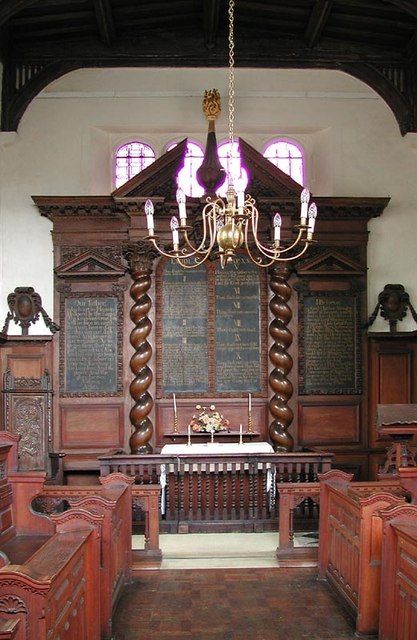
The chapel keeps its original west door in a carved late 17th-century doorcase, and the original black and white marble floor in the sanctuary.19,37,114 The Trust's guidebook says rails like these were recommended by Archbishop Laud so that dogs could not defile the sanctuary, and that the columns here stand so close together that not even a puppy could get through.321 The Fund's notes add that the seventeenth-century communion rails now run round three sides of the altar, and that a further carved rail was put in further west in 1897.114
The east end is filled by a tall oak reredos. Two twisted columns frame the Ten Commandments, with the Lord's Prayer and the Creed beside them in gold on black.19,35 The Victorian chaplain Newton Price thought it was put up about 1690, using oak from the old house pulled down in 1688.18,37 Bray says it was whitewashed in the eighteenth century and that the whitewash was taken off again in the nineteenth.318
Bray says the chapel's old bell, cast by John Walker in 1704, now hangs in St Matthew's church in Oxhey village. The Trust's guidebook dates the bell-cote to 1704 and the bell John Walker cast for it to 1707.321318 A bell still hung in the chapel in the 1950s, and a new bell turret was built in 1963.319,322 The bell in that turret was cast for St Matthew's and brought here in 1887, when that church was given a new ring of bells.322
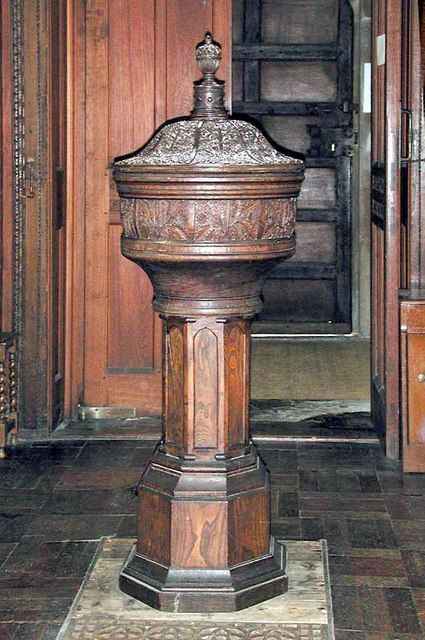
The chapel's carved oak font has a domed cover and an urn on top.19,114 Bray dates the font to 1712, while the Trust's guidebook calls the bowl and its cover seventeenth-century work321 Bray gives its height as 42 inches without its cover, and Wray's article adds that it has a heavy lead basin inside for the water.318,319 The 1872 sale particulars singled out "a handsome Altar Piece and elaborately Carved Font".20 Wray's article also says the font had been moved to the new church next door and was still in use there.319 Whatever happened, the font is in the chapel now. Photographs taken inside, and a visit in 2013, show it, and the list entry describes it there.19,323,324
John Askell Bucknall, who died on 25 August 1796 aged 78, was also buried here, and his relations put up a marble monument to him in 1797.18,19,35 There is no churchyard, because the chapel was never a parish church. The Trust's guidebook names the two graves in the paved enclosure by the entrance: Samuel and Frances Judd, who died in 1944 and 1946 and who lived and worked at Oxhey Place Hall, and Thomas Anthony Blackwell, who died in 1942.321 It credits the Bucknall memorial to C. Regnart of London, in the Adam style, and records the brass plaque below it marking the building of the chapel in 1612, with its text from Ecclesiastes: "Take heede to thy foote when Thou enterest into the House of God and bee more neere to Heare then to give the sacrifice of Fooles".321 A small paved enclosure at the west end holds two graves.114,325 One is the grave of Anthony Blackwell, owner of the Oxhey estate, who was killed in an explosion on war service on 5 July 1942.68,88 The other is the double grave of a couple who both worked on the estate, who died in 1944 and 1946.325
The north wall carries drawings of the inside before and after 1897, and a framed copy of the charter of 1007. The panelling on the north side of the sanctuary carries the names of the men who died in the First World War, put up by relations and friends of the Blackwell family.321 Painted texts in cartouche frames survive under the limewash, and one on the north wall has been uncovered, the opening of Psalm 46: "God is our hope and strength, a very present help in trouble".321 The communion table came from the wooden mission church of St Alphege, built east of the railway in 1944 and pulled down when All Saints was built, and the chair carved with gothic and linenfold panels stood in St Albans Abbey until 1923, when it went to the Watford Peace Memorial Hospital.321114
Soldiers and blocked windows
A note on Our Oxhey says the chapel was used as a store and barracks by Cromwell's army after the Battle of Uxbridge, that the soldiers took lead from the roof to make musket balls and cut a new doorway in the east wall, and that Sir John Bucknall blocked that doorway up in 1688.326 The Redundant Churches Fund's notes date the soldiers to 1649 and say they desecrated the building.114 Wray's article stops short of that. It says only that the small bricked up doorway at the foot of the east wall is thought to have been put in during the Commonwealth, when the chapel may have been used as a barn.319
Nigel Lee doubts the soldiers. He says there is no evidence Parliament's forces damaged the chapel, because John Heydon, who owned the estate from 1639 until he sold it in 1668, sat on the Hertfordshire committee that raised money for Parliament from 1642 until 1660 and would have worked with them.18,326 His reading is that the east and north windows were blocked to hide lights from Royalist troops moving up the Colne valley.326
Ivy and a chapel of ease
Services went on until 1799, when the later mansion that replaced the old house was pulled down. For the next half century the chapel was used chiefly as a lumber store.18,37,327 Bray says it stood unused until the repairs of 1852, apart from two burials, those of the Rev. Harbottle Grimston in 1823 and his sister the Hon. Sophie Elizabeth Grimston in 1826.318
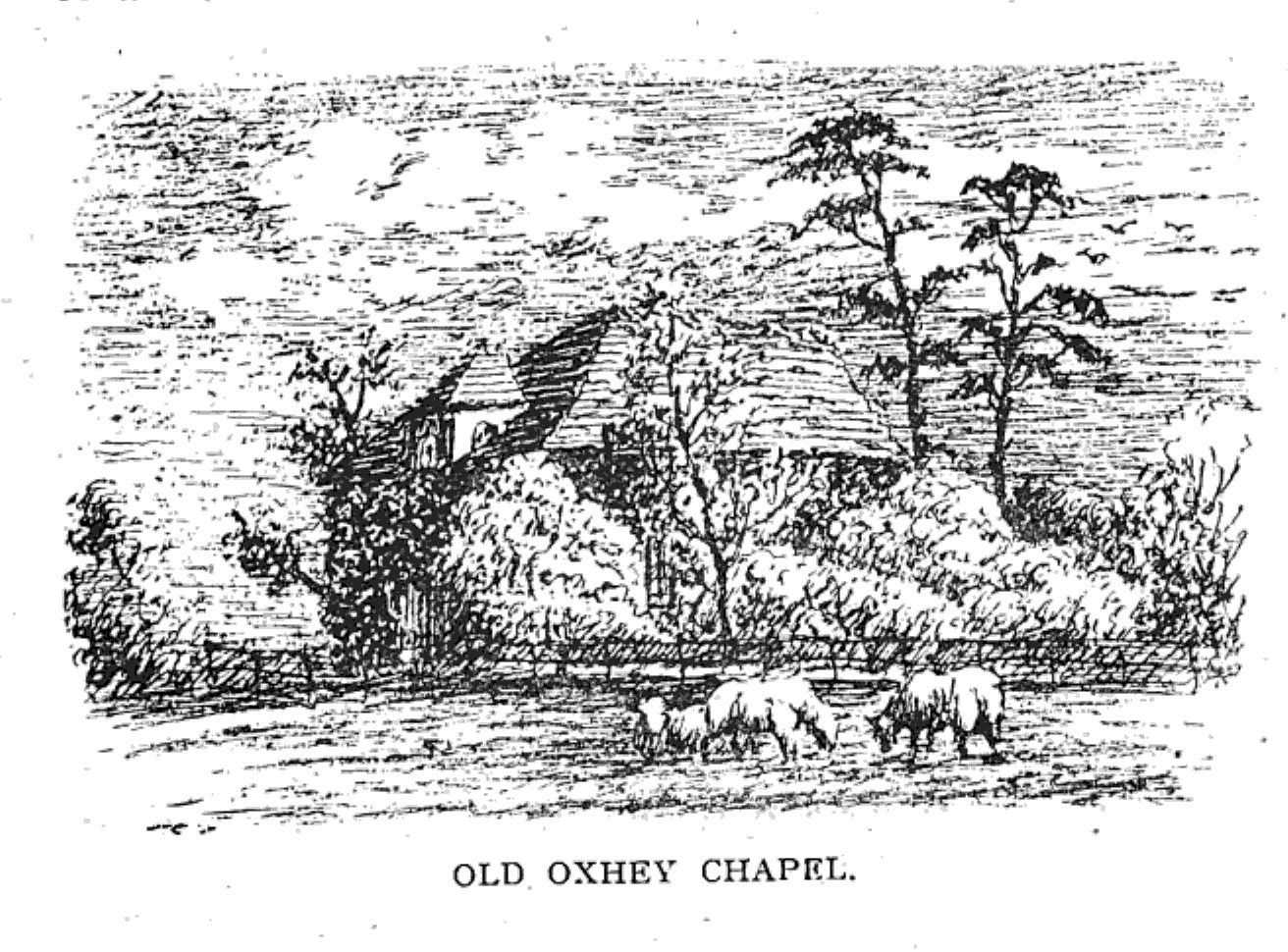
In 1852 it was repaired for the Estcourt family and reopened for local people.19,36,43 Bray describes a sketch signed H.H.T., published in 1860 in The Twelve Churches, or Tracings along the Watling Street. It shows the chapel with no porch, its original west window, and the wooden door that was later moved forward to become the porch door.318 When the estate was sold in 1866 the buyer had to keep the chapel and its vaults in repair for ever, for Church of England worship only.318 Bray adds that the seller kept the right to come and see the chapel and its monuments twice a year, on foot or by carriage, and to send workmen in to repair them.318 The Home Counties Magazine, writing up Newton Price's notes in 1899, said the 1852 repairs were "not very judiciously executed" and that a good deal of interesting Jacobean work was "no doubt" destroyed.327
The particulars for the auction of 3 July 1872 end with a warning that "the present arrangement" for services would stop at Michaelmas.20
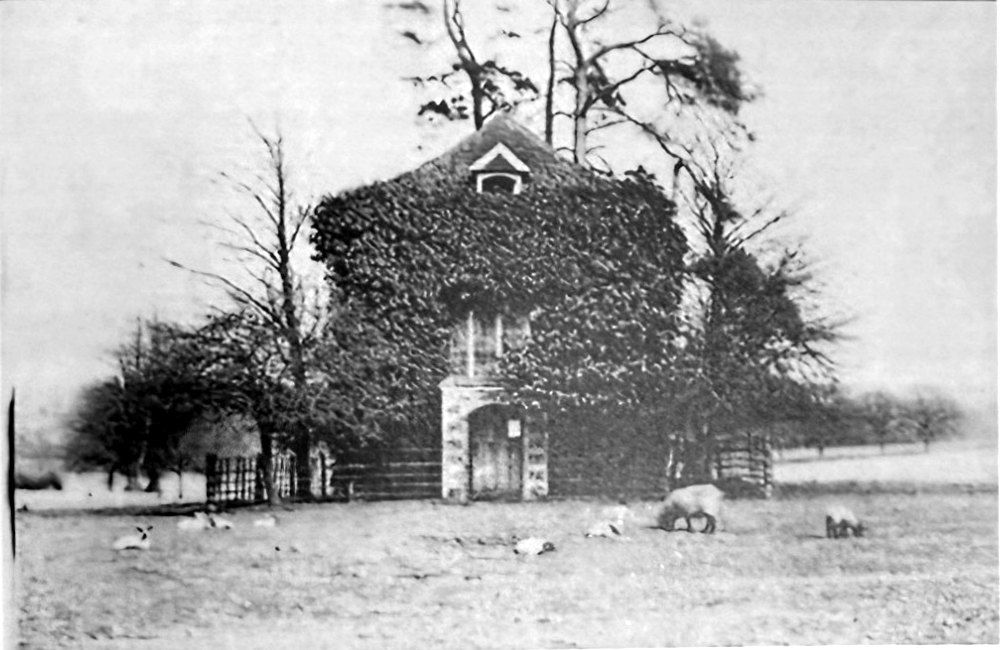
About 1881 J. E. Cussans saw "a small brick building, nearly covered with ivy", standing alone in a meadow east of Oxhey Place farm with three large Scotch firs at its east end.35 H. J. Foley, in the "Around Bushey" chapter of his 1889 book Rural Rambles: The Herts Border, said it was "still used as a Chapel-of-ease to Watford", and that worshippers reached it along a private road under the railway at Carpenders Park.57 A history of Oxhey village recalls older residents who said they walked across the fields on Sundays to the little old chapel by the big house, and were allowed to worship there with the family and the servants, because there was nowhere else within easy reach.55 A photograph from about the 1890s shows it thick with ivy, with sheep grazing round it.158,328
The chaplains
Bray follows the chaplains from the reopening. The owner who had the chapel repaired in 1852 appointed the first of them, Henry Bethune Sands, the year before he died.318 Nigel Lee says Newton Price, who came in 1872, was paid out of subscriptions from local gentry, among them Carnegie of Eastbury and W. H. Smith.36 Price went on to be the first vicar of St Matthew's in Oxhey village.318
| From | Chaplain |
|---|---|
| 1852 | Henry Bethune Sands |
| 1854 | The Rev. Mr Cameron |
| 1856 | Richard Lee James, in post when W. H. Smith bought the estate |
| 1868 | Astley Roberts |
| 1872 | Newton Price |
| 1918 | The Rev. Herbert Allen, vicar of Oxhey |
The names to 1868 come from Bray, 1872 from Lee, and 1918 from Kelly's Directory of Watford for 1925, which says Allen had been chaplain since that year.36,43,318
The 1897 restoration
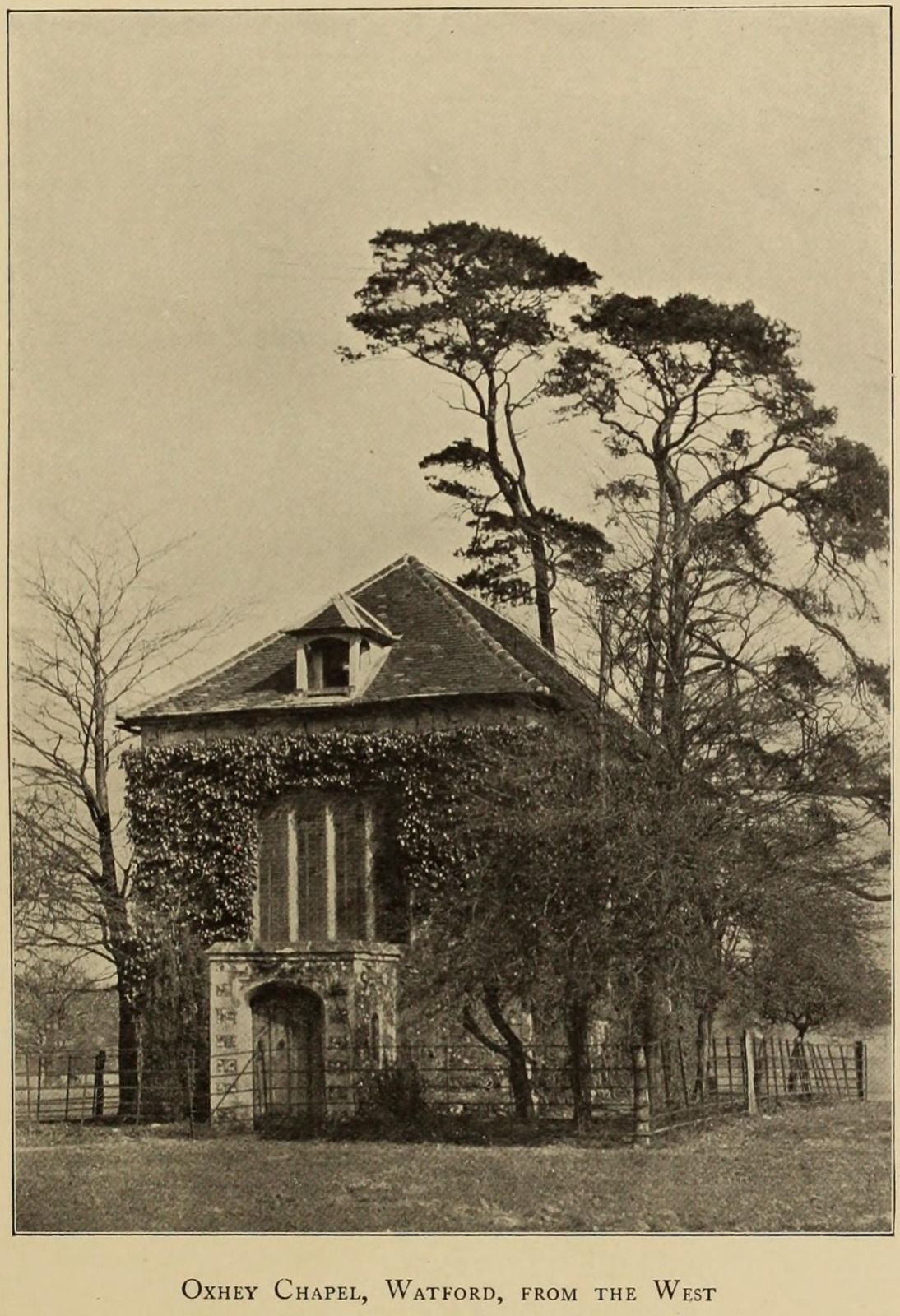
In 1897 the chapel was restored for T. F. Blackwell by the architect J. E. K. Cutts. The Trust's guidebook names the practice as J. E. K. and J. P. Cutts, brothers who designed several London suburban churches, and says they added the western porch and vestries, opened up the blocked northern windows and put in the present seating, in teak, with a B for Blackwell carved in the western stalls.32119,43,61 The list entry says a narthex, or entrance hall, was added at the west end in 1897, and the Redundant Churches Fund's notes say the vestries were added then, though some local accounts say a porch was already there and only the vestries were new.19,114 Nigel Lee is firm about it. He says the porch went up after the 1852 repairs and that only the vestries were new in 1897, which fits the sketch of 1860, and he says the photograph Our Oxhey captions about 1897 was taken before the work.318,328
Five Tudor windows were restored where their outlines were found, and the 1852 stained deal fittings gave way to teak stalls facing each other, as in a college chapel.18,19,43 Lee's account of the work adds that the east and north windows were unblocked, that the eighteenth-century south windows were changed to a four-light perpendicular pattern, and that the west window was left as it was.36 By 1910 the chapel was in good condition, and in 1925 it was still used for services, with the vicar of Oxhey as its chaplain.37,43 Kelly's describes it then as lit by six Tudor windows, with an oak ceiling and the reredos filling the whole east end.43
Cutts's great-grandson has posted five of the architect's own photographs on Our Oxhey, two of the outside and three of the inside, taken at the time of the restoration. He says Cutts called the building the Ancient Oxhey Chapel, and that the albums went with the family to Canada in 1912.61
An undated newspaper notice reprinted on Our Oxhey records the death of the chapel keeper, a woman of 83 who had kept the building in excellent order for years and who never accepted the restoration.329 Lee writes that a row broke out at the turn of the century over whether the chapel was a public parochial building, and that for years afterwards repairs were very hard to get done.36
Left out of the purchase
When the London County Council bought the estate, it said it would leave "a church and burial ground on the site" untouched.99 Poor But Proud says the chapel was left out of the 1944 order, and the order map shows a small patch by the chapel coloured green.21,158 The St Matthew's history says the purchase included it, but the 1963 appeal shows the Blackwell estate still owned it.101,158 The full story of the order is in The 1943 Housing Order.
A church for the new estate
From 1948 the first council tenants worshipped in the chapel.114,158 It served until All Saints was built just to the north. The Redundant Churches Fund's notes give 1953 for the new church and Poor But Proud gives 1954.114,158
Nigel Lee wrote in 1971 that Anthony Blackwell's widow once suggested pulling the chapel down and moving her husband's coffin. The Rev. Basil Whitworth, then priest at St Alphege's in Carpenders Park, talked her out of it.36,158 The date is not recorded, but St Alphege's was only open from 1944 to 1954, which places it in those years.100
Bray says the chapel went on the scheduled buildings list in 1951, described then by its chequerboard walls, Tudor drip moulds and sprocket eaves, noted as seating forty and graded B.318 The list entry dates its first listing to 1 September 1953.19
After All Saints opened, the chapel still had some midweek services, and its bell was rung for All Saints, which had none of its own.319 Residents remember ringing it. One rang it on Sunday mornings in the mid 1950s, and another, made a steward by the Rev. Basil Whitworth, rang it for the start of the junior service at half past ten between about 1957 and 1959.279 By the early 1960s the chapel stood unused and falling into disrepair.114,158 What the estate's other congregations did in these years is in Churches.
The winter of 1962 to 1963
In the hard winter of 1962 to 1963 part of the roof gave way under the snow.114,153,319 A tarpaulin covered the hole, and the vicar, the Rev. E. Charles, told the Watford Observer the chapel was "in a ruinous condition", with repairs put at £5,000 to £6,000.153 He said there was a determination to preserve the only old building on the estate, and that once restored it would probably be used for baptisms and adult discussions, with new heating and lighting.153 The public appeal was not to open until the autumn, but the Watford Archaeological Society had already given £5.153
The appeal report says the roof was riddled with woodworm as well as snow damaged.159 When the steep tiled roof was stripped, the builders found an older, fairly flat roof underneath that had once been covered in lead.159,319 Gladys Wray wrote that the ends of nearly all the heavy oak beams turned out to be badly decayed, which made the job much bigger than anyone had expected and left doubt whether the money would stretch to the rest of the repairs.319
The two copper beeches beside the chapel, at least 120 years old, were judged dangerous and felled, and four saplings were planted further away.330 Two experts were called in first, one from Herts Forestry Ltd and one from Oxford University. The tree between the chapel and the new church was rotten, and the one towards the vicarage was weak where it had been grafted, and the Watford Observer reported that the pair had helped rot the roof by holding the rain and keeping off the sun.330 Nigel Lee says the beeches also damaged the foundations, and that the steps down to a fireplace under the chapel floor were filled in as a result. He noted in 2025 that another tree was growing close to the south wall.330
The 1963 appeal
The Watford Observer's report of 1963 quoted the vicar saying the Church of England had only bought the chapel the year before, which would put it in 1962.153 Other accounts say the Blackwell estate finally handed the chapel to the Church of England in September 1963.158,159 We cannot settle which is right.
In December 1963 a printed leaflet launched the Save the Oxhey Chapel Fund. It called the chapel the only historic building on the whole Oxhey estate and Carpenders Park.158 It warned that the first estimate of up to £6,000 would not now cover redecoration, light and heat. The Diocese of St Albans would save the structure, it said, but was reluctant to spend more in a parish that already had a church while other new estates had none.158
A newspaper report put the appeal at £6,500 and said copies had gone to every house in the parish.159 If enough came in, the hope was to heat and light the chapel and use it again for services and discussions, and as a centre for all Christians in the area.159 Gladys Wray's article in Hertfordshire Countryside asked readers to send contributions to the vicar at All Saints' Vicarage in Gosforth Lane.319
The leaflet carried 29 names.158 They included:
- Gilbert Longden, MP for South West Hertfordshire158,331
- county councillors, and the chairmen of Watford Rural District Council and Watford Rural Parish Council158
- the vicar and churchwardens of All Saints, and the Rural Dean of Watford158
- the ministers of St Martin's Presbyterian and South Oxhey Methodist churches, and the pastor of South Oxhey Baptist Church158
- the headmasters of Clarendon and Hampden schools158
- the South Oxhey Chamber of Commerce and the local archaeological society158
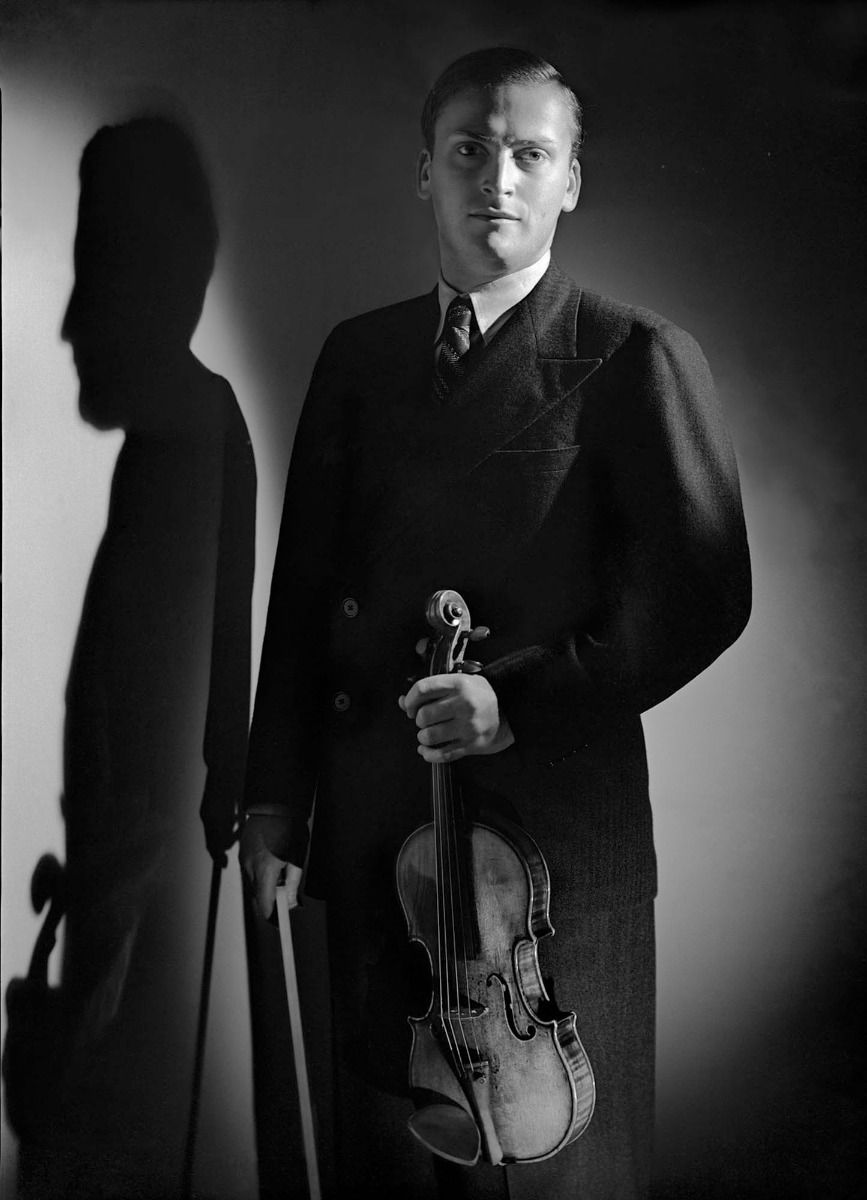
- the poet John Betjeman and the violinist Yehudi Menuhin158
A newspaper explained the two famous names. Betjeman had heard his tobacconist was moving to South Oxhey and told him to go and see the chapel, which Betjeman remembered standing in open fields. The vicar, the Rev. Edward Charles, then wrote to ask for his help.159 Menuhin was approached because the chapel's old weathered roof tiles were being used to restore his home in Highgate.159,322
The 1960s restoration
The hipped roof came down and was rebuilt to the chapel's original 1612 pitch, with its tiles and timbers replaced and a new bell turret and cupola on top. The Trust's guidebook names Seely and Paget as the architects of that restoration, says the chapel passed from the Blackwell family to the vicar of All Saints and the diocese at the same time, and adds that the old roof tiles were sold to the violinist Yehudi Menuhin for his cottage in Highgate Village.32119,158 A plaque in the east gable carries the dates 1612 and 1963.19 The Redundant Churches Fund's notes describe the result differently, as a copper covered roof within a parapet, with a hexagonal bell cote, both dating from the 1963 work.114 A newspaper report put the cost at £7,000. The diocese paid most of it, with £700 from the local appeal and £500 from the Historic Churches Preservation Trust. The report names the architect in charge as A. S. B. New.332
The same report describes a bishop, the Rt Rev. A. J. Trillo, dedicating the restored chapel alongside the new All Saints church hall and six stained glass windows.332 Its date is unsettled. The Our Oxhey local history website dates its copy 1961, which is before the roof failed. Nigel Lee gives October 1964, but the report calls Trillo Bishop of Hertford, a post he did not hold until 1968.332,333
Redundancy and the Fund
A resident remembers a christening in the chapel in 1971.279,323 By 1973 the parish had decided it no longer needed the chapel.114,158 An Order in Council of 17 March 1976, made under the Pastoral Measure 1968, confirmed a scheme declaring it redundant.172 Another, of 21 December 1977, made the Redundant Churches Fund responsible for its care.173 The Fund was set up under that 1968 Measure and is now called the Churches Conservation Trust.172,334 Its notes say the repairs that followed were done by R. Gibson of Northwood, under the architect P. J. E. Mark.114
In 1979 the Watford and South West Herts Archaeological Society called the chapel a building of outstanding interest that must be preserved at all costs, and pointed readers to Marjorie Bray's paper in Hertfordshire's Past, volume 3, of 1977.335
Open again to visitors
In 1993 the chapel was opened to the public on 1 and 2 May, as part of a year of events called Oxangehaege 93.187 The Watford Observer said several murals that had been hidden under limewash for decades were on show, along with a collection of old pictures of the chapel and a chair from St Albans Abbey. The chair had gone to the Peace Memorial Hospital, and a passer-by rescued it from a skip when the hospital closed and gave it to the chapel.187 The custodian, Arthur Bowerman, who had looked after the building for 13 years by then, said visitors were surprised by the splendour of a place that is hard to find, and that the Bishop of St Albans had called in at the start of the year.187 A community festival followed at Warren Dell school on the May bank holiday, with stalls, fair rides, clowns and donkey rides, and 1,200 copies of a modern version of St Luke's gospel were printed to give out. A children's holiday club, a flower festival and a visit by the Bishop of Hertford were to come later in the year.187
The Trust's guidebook says he was custodian from 1979 until his death and that he was known as WAG.321 Bowerman, who was born in 1916 and took up volunteering when he retired, received the MBE on 22 July 1998 for his services to the chapel and the Churches Conservation Trust, and the Watford Observer later named him a local hero. He died in 2004.193
Our Oxhey's editors were given a tour and a short talk in the chapel on Friday 4 October 2013, and photographed the inside. Their pictures include a war memorial, the Altham and Bucknall monuments, the font and the memorial to Anthony Blackwell.324
The chapel today
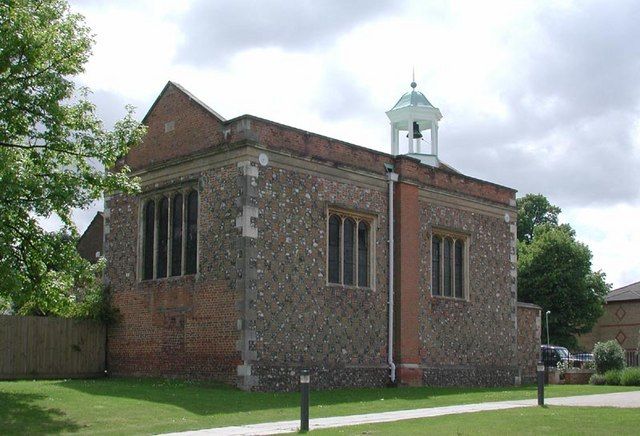
The chapel stands between All Saints and its vicarage, with the 1940s estate all around.317,336 It is now listed Grade II*.19 Pevsner called it the best individual building at Oxhey.318,322
The chapel is still consecrated, and All Saints holds its carol service there on the last Sunday before Christmas, weather permitting.320,325 Our Oxhey's note on the chapel also says it can still be visited and is used at times for weddings.326 To see it for yourself, turn to Visit.